
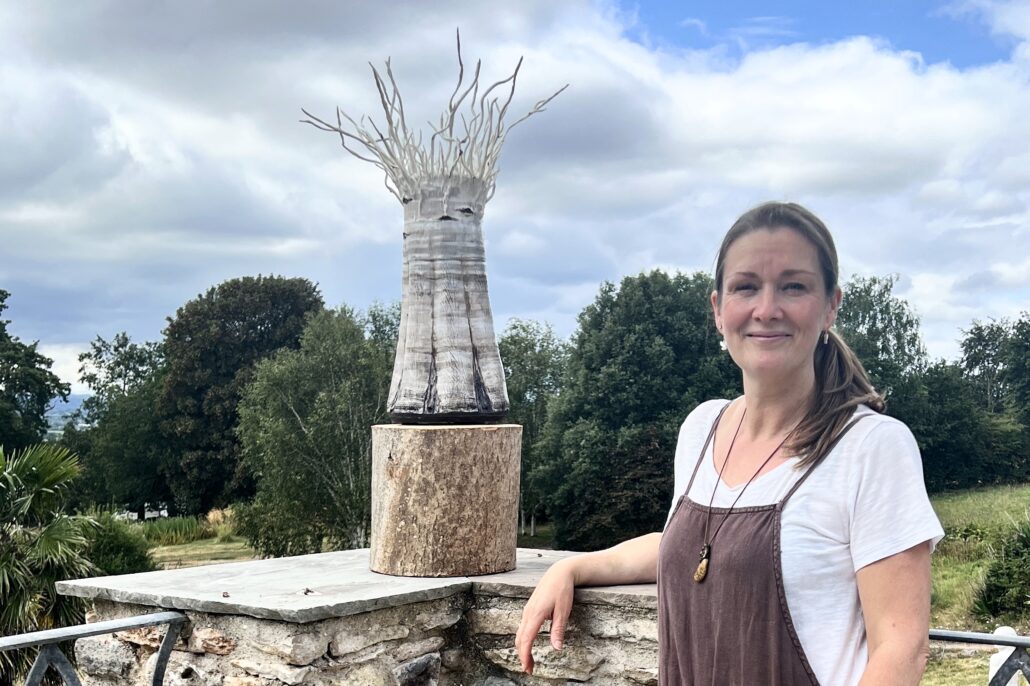
Beyond Horizons at Stoberry Garden Park: Beneath, Between, Beyond for Somerset Art Weeks 2026
From 4 September to 5 October 2026, my sculpture Beneath, Between, Beyond will be shown in Beyond Horizons at Stoberry Park, Wells, an outdoor sculpture exhibition connected with Somerset Art Weeks 2026. The setting feels especially meaningful for this work, because Stoberry’s six-acre garden is shaped by trees, water, changing viewpoints and long views across the Somerset landscape. The exhibition also meets the festival theme, Cultural Connections, through relationships that extend across people, place and the more-than-human world.
My piece grew from the way I experience trees as living participants within their environment. The tall ceramic vessel carries a bark-like surface marked by darker lines, while pale branching forms rise from its opening and reach into the surrounding space. I wanted the sculpture to suggest what can be seen above ground, what is carried below it and what moves quietly between both realms.
What inspired Beneath, Between, Beyond?
When I spend time with trees, I sense their individuality and their place within a wider living community. Each trunk holds the record of weather, growth, damage and repair. Branches turn towards available light, roots respond to water and soil, and the whole tree adjusts continually to the conditions around it.
The title Beneath, Between, Beyond reflects three layers of this relationship. Beneath the visible tree, roots meet soil organisms and fungi. Between trees, materials and signals may move through shared ecological pathways. Beyond the tree itself, its presence reaches birds, insects, other plants, the wider atmosphere and the people who pause beneath its canopy.
In making the piece, I wanted clay to act as a translator. The vessel form gives the work an interior space, while the branches carry its energy outwards. Its pale surface recalls birch bark and woodland light, and the darker markings suggest roots, scars and traces of growth held within the trunk.
How do trees communicate through mycorrhizal networks?
Many trees form symbiotic relationships with mycorrhizal fungi. The fungi extend fine threads, known as hyphae, through the soil and connect with plant roots. Trees provide carbon produced through photosynthesis, while fungi help plants access nutrients and water. In some settings, these fungal pathways form common mycorrhizal networks linking neighbouring plants.
Research has shown that resources and defence-related signals can sometimes pass through these networks. Studies involving Douglas fir and ponderosa pine found evidence of carbon transfer and stress signalling between connected trees following defoliation. Other research has shown that access to root-associated fungal networks can influence the growth and survival of tree seedlings.
The science is continuing to develop, and forests contain cooperation, competition and many relationships that resist simple human comparisons. I find the evidence deeply moving because it reveals how much of a forest’s activity happens beyond our sight. The ground beneath us is active with exchange, response and connection.
What can trees teach us about connection?
Trees remind me that strength can be relational. A tree stands through its own structure, while its life also depends upon sunlight, water, fungi, microorganisms, neighbouring species and the conditions of the wider landscape. Its boundaries remain distinct and its wellbeing is woven into many connections.
This understanding has shaped the way I approach ceramic art. My nature-inspired sculptural vessels begin through observation and embodied response. I spend time with a tree, surface or landscape until something settles within me, then allow that memory to move through my hands and into clay.
“Trees show me that connection can be quiet, unseen and sustaining. Clay gives me a way to honour that intelligence through form.”
When people encounter Beneath, Between, Beyond, I hope they feel invited to consider their own relationship with trees. We breathe the oxygen supported by photosynthesis, rest in their shade, receive their beauty and share environments shaped by their presence. Time among trees can also support restoration, attention and a greater sense of nature connection.
Visit Beyond Horizons during Somerset Art Weeks 2026
Beyond Horizons takes place at Stoberry Park in Wells from 4 September to 5 October 2026, overlapping with Somerset Art Weeks from 19 September to 4 October. The garden setting allows sculpture to be experienced alongside growing, weathering and seasonal change, giving each work an active relationship with its surroundings.
I warmly invite you to visit and meet Beneath, Between, Beyond within the landscape that will hold it for the exhibition through changing light and autumn weather. As you stand with the piece, perhaps notice where your attention travels: towards the visible branches, the vessel’s inner space, or the imagined network continuing beneath your feet.
You can also explore my Tree Vessels and other nature-inspired ceramic collections through the Collections section of my website. For enquiries about available work, gallery collaborations or a bespoke ceramic sculpture commission, please visit the Contact page.
References
Bratman, G.N., Hamilton, J.P., Hahn, K.S., Daily, G.C. and Gross, J.J. (2015) ‘Nature experience reduces rumination and subgenual prefrontal cortex activation’, Proceedings of the National Academy of Sciences, 112(28), pp. 8567–8572.
Liang, M. et al. (2020) ‘Soil fungal networks maintain local dominance of ectomycorrhizal trees’, Nature Communications, 11, article 2636.
Somerset Art Works (2026a) ‘Beyond Horizons: Sculpture at Stoberry Park, Wells, Somerset’. Somerset Art Works.
Somerset Art Works (2026b) ‘Somerset Art Weeks Festival 2026: Cultural Connections’. Somerset Art Works.
Song, Y.Y., Simard, S.W., Carroll, A.W., Mohn, W.W. and Zeng, R.S. (2015) ‘Defoliation of interior Douglas-fir elicits carbon transfer and stress signalling to ponderosa pine neighbours through ectomycorrhizal networks’, Scientific Reports, 5, article 8495.
Stoberry Park (2026) ‘The Garden’. Stoberry House and Garden.