
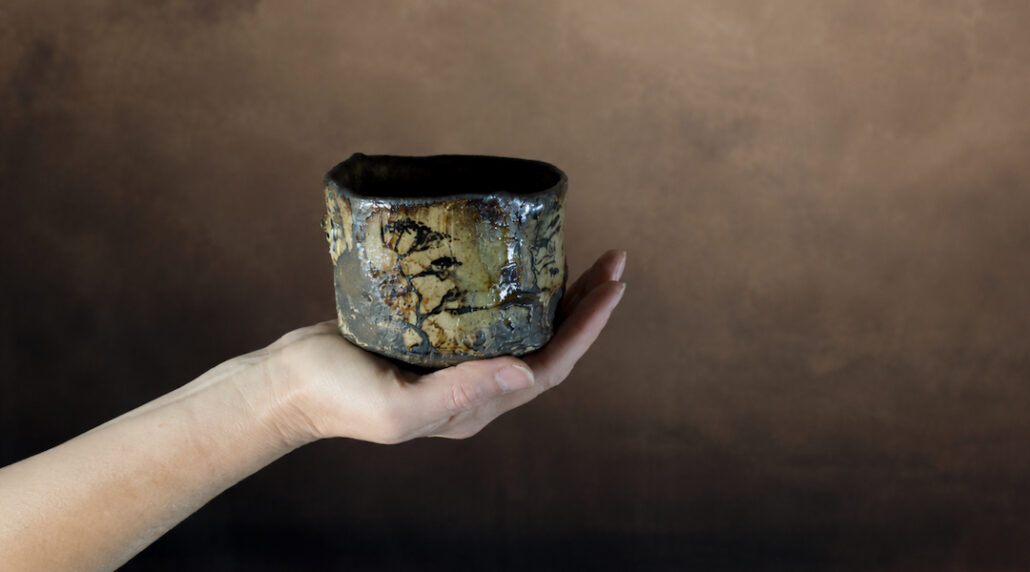
Kurinuki, Wabi-Sabi and Chawan: Finding Beauty in Handmade Japanese-style Drinking Vessels
There is something about a drinking vessel made by hand that changes the way I experience what it contains. I notice its weight, the place where my fingers settle, the unevenness of its rim and the texture beneath my palms. The simple act of drinking becomes slower and more conscious.
This is one of the reasons I have become drawn to kurinuki pottery, and particularly to making chawan and smaller kurinuki drinking vessels. The process encourages many of the qualities that already sit naturally within my ceramic practice: presence, material honesty, irregularity and a willingness to listen to the clay rather than asking it to conform.
It also brings me into conversation with the Japanese aesthetic traditions of wabi and sabi, commonly brought together today as wabi-sabi.
What is kurinuki pottery?
Kurinuki is a traditional Japanese ceramic hand-building technique that begins with a solid block of clay. Rather than building the walls of the vessel upwards or throwing them on a wheel, the maker removes material, hollowing and carving until an interior and exterior form gradually emerge.
I find this reversal fascinating. When throwing, I begin with clay and create space through movement and expansion. With kurinuki, the space is already hidden within the block. My role is to discover it.
Carving inevitably leaves evidence of the process. A tool catches slightly differently in one area. An edge remains irregular. One side feels heavier or quieter than another. The finished kurinuki vessel contains the memory of its making very clearly. For me, these are not imperfections requiring correction. They are part of the relationship between hand and material.
How does wabi-sabi relate to Japanese ceramics?
Wabi-sabi is often described simply as the Japanese appreciation of imperfection, although its meaning is richer than this familiar interpretation suggests. Historically, wabi became closely associated with simplicity, restraint and finding richness within modest surroundings, particularly through the development of the Japanese Way of Tea. Sabi carries associations with ageing, patina and the quiet beauty that develops as something experiences time. Together, they encourage an appreciation of things that feel natural, transient, individual and quietly incomplete.
This resonates deeply with the way I already understand clay. A handmade ceramic vessel is never completely static. Fire alters it, glazes move, surfaces develop. When a vessel is used regularly, it continues to gather the subtle evidence of touch and time. Its relationship with its owner deepens through experience.
“Wabi-sabi reminds me that a vessel does not need to be perfect to feel complete. Sometimes it is the mark of the hand, the irregular edge or the changing surface that allows us to connect with it.”
Wabi, chawan and the Japanese Way of Tea
The relationship becomes particularly meaningful when considering the chawan, the bowl traditionally used for preparing and drinking matcha during chanoyu, the Japanese Way of Tea.
During the sixteenth century, tea culture increasingly embraced a wabi aesthetic. Tea master Sen no Rikyū became closely associated with wabi-cha, an approach that valued simplicity, quietness and objects whose beauty could be experienced through use rather than display alone. Tea bowls became an important expression of these ideas.
Some of the most highly regarded Japanese chawan possess forms that may appear irregular when judged against conventional ideas of symmetry. Their surfaces reveal clay, glaze and firing, while their scale and shape relate directly to the hands that hold them.
The experience is therefore tactile as much as visual. You turn the bowl, feel its weight, notice its rim and experience the warmth passing through clay from the tea within. The vessel becomes part of the ritual.
Why kurinuki feels so appropriate for chawan
Kurinuki and chawan sit beautifully together because the technique naturally encourages individuality. When I carve a kurinuki drinking vessel, I cannot reproduce every cut exactly. Removing clay becomes an intuitive conversation. I have to respond to what has already happened and decide where another mark is needed, where more material should remain and when the vessel has reached its natural conclusion.
This creates a very different experience from attempting to make something completely uniform. A kurinuki chawan may therefore feel slightly different depending on how it is turned in the hands. One side may invite the thumb. A carved plane may catch the light. A small irregularity in the rim may become the place from which someone naturally chooses to drink. The person using the vessel becomes part of its continuing story.
Chawan, kurinuki and my own ceramic practice
There is another reason these Japanese ceramic traditions speak to me. My wider practice explores whether ceramic vessels can become activators for wellbeing, and much of this involves bringing attention back towards touch, nature and presence.
A kurinuki drinking vessel does this almost automatically for me because it encourages sensory awareness. I feel the clay rather than simply holding a smooth, anonymous surface. My chawan and kurinuki vessels retain traces of making because I want them to feel connected to their material origin. Clay comes from the earth, and I am interested in allowing some sense of earthiness to remain after firing.
There is also something very grounding about wrapping both hands around a drinking vessel. The warmth of tea passes through the ceramic. Fingers encounter different surfaces and the body naturally becomes involved in what might otherwise be an unconscious daily act.
“My kurinuki vessels ask to be held. I love the idea that something as ordinary as drinking tea can become a small moment of touch, presence and reconnection.”
Wabi-sabi as something we experience
Perhaps this is what I value most about wabi-sabi. It is not simply an aesthetic style that can be applied to an object, it is experienced through relationship. A chawan gains meaning through being held and used. A kurinuki vessel reveals itself gradually as fingers learn its contours.
Surfaces change with time, while tiny irregularities become familiar rather than distracting. There is something gentle in accepting an object in this way. It reminds me of walking through woodland, where no two trees grow symmetrically and no weathered surface remains unchanged.
Nature rarely presents us with perfection, yet it continually offers balance, beauty and belonging. Clay allows me to bring a little of that understanding into the hand. You are invited to explore my chawan and kurinuki drinking vessels within the Collections section of my website. Perhaps, when you next hold a handmade cup or tea bowl, notice where your fingers naturally settle and how the surface feels against your hands.
What changes when drinking becomes something you experience, rather than simply something you do?
References
Japan House London (2026) ‘Key words related to the Hyakkō: 100+ Makers from Japan exhibition’. London: Japan House London.
Japan House London (2026) ‘Wabi-sabi and Japanese craft: nature or nurture?’. London: Japan House London.
Kyoto National Museum (2022) Chanoyu: Tea in the Cultural Life of Kyoto. Kyoto: Kyoto National Museum.
Metropolitan Museum of Art (2011) ‘The Japanese Tea Ceremony’. New York: The Metropolitan Museum of Art.
Morikami Museum and Japanese Gardens (2026) ‘Kurinuki Ceramic Workshop’. Delray Beach, FL: Morikami Museum and Japanese Gardens.
Smithsonian National Museum of Asian Art (2017) Imperfectly Beautiful: Inventing Japanese Ceramic Style. Washington, DC: Smithsonian Institution.
Victoria and Albert Museum (2024) ‘Ceramics: A Risky Business’. London: Victoria and Albert Museum.