Sculptural Ceramics for Collectors

Sculptural Ceramics for Collectors: Choosing Work with Presence, Meaning and Lasting Connection

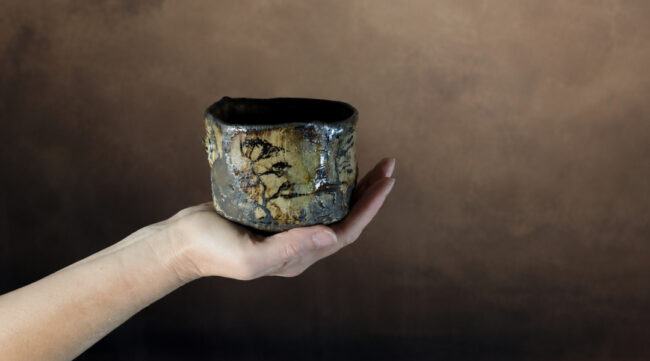
Collecting sculptural ceramics is often a quiet and personal act. It begins with recognition. A form, surface or texture seems to speak before the mind has fully understood why. The piece may carry a sense of stillness, movement, earth or memory. It may feel as though it already belongs somewhere within the home, waiting to be encountered slowly over time.

For collectors, sculptural ceramics offer something distinct within contemporary art. They hold the trace of the hand, the intelligence of material and the presence of form. Unlike objects made through mechanical repetition, handmade ceramic pieces carry the subtle evidence of touch, pressure, decision and response. This is part of their value.

In my own practice, I am drawn to the vessel because it holds possibility. A vessel may be functional, sculptural or contemplative. It may hold flowers, light, shadow, silence or memory. It is a form that invites relationship, which is why sculptural ceramics for collectors can become meaningful far beyond their visual presence.

Why do collectors choose sculptural ceramics?

Collectors often choose ceramic work because it offers both material depth and emotional resonance. Clay is ancient and immediate. It comes from the earth, responds directly to the hand and is transformed through fire into something lasting.

This transformation gives ceramics a particular power. A vessel begins as soft, responsive material, then becomes permanent through heat. It carries the vulnerability of making and the strength of survival. For many collectors, this combination of delicacy and endurance is deeply compelling.

Sculptural ceramics also sit beautifully between fine art, craft and design. They can be displayed in a gallery, placed within an interior or lived with in a domestic space. This flexibility does not lessen their artistic value. It gives them intimacy.

A painting is usually viewed from a distance. A ceramic vessel can be viewed, circled, held, placed and lived alongside. It changes through light, season and mood. It becomes part of the atmosphere of a space.

What makes ceramic art collectable?

Collectable ceramic artists are often recognised for a clear relationship between material, process and meaning. The strongest work is not simply well made. It carries a distinct voice.

For collectors seeking contemporary ceramic artists in the UK, this voice may be found in how an artist handles form, surface, scale and concept. It may be present in a repeated motif, a particular relationship with landscape, or a commitment to material research. It may also appear in the quiet consistency of a body of work over time.

In my own work, nature is not used as decoration. It is part of the making process. Trees, forest floors, wild clay, seasonal light and organic surface responses all influence the final vessel. Each piece is shaped through observation, memory and touch, allowing clay to act as a bridge between human experience and the natural world.

This is important for collectors because a ceramic piece gains depth when it is connected to an authentic practice. The object is not isolated from its maker. It carries the research, sensitivity and intention behind it.

Bespoke ceramic sculpture commissions for collectors

A bespoke ceramic sculpture commission allows a collector to become part of the creative process in a more personal way. Rather than choosing only from available work, a commission opens a conversation around place, scale, atmosphere and intention.

This might involve a vessel created for a particular room, a made to order ceramic piece for a meaningful setting, or a site-specific ceramic installation that responds to the architecture and emotional tone of a space.

Commissioned ceramic artwork in the UK is increasingly valued by collectors who want work that feels personal without being decorative in a superficial way. A bespoke piece can respond to a collector’s connection with nature, memory, place or material. It can also be shaped with sensitivity to the light, colours and textures of the space where it will live.

For me, a commission begins with listening. I want to understand not only where the piece will be placed, but what kind of presence it needs to hold. Some pieces call for quiet grounding. Others ask for more movement, height or texture. The clay itself also contributes to this conversation, guiding what is possible and what feels true.

How do ceramic vessels live within a collection?

A sculptural ceramic vessel can sit alone as a focal piece, or it can become part of a wider collection of contemporary clay art, paintings, textiles, glass or natural materials. Its role depends on scale, surface, form and placement.

Some collectors are drawn to larger vessels because they create a strong point of stillness within a room. Others prefer smaller works that invite closer attention. In both cases, the ceramic piece offers a tactile presence that can soften and deepen an interior.

Custom ceramic vases for interiors may be chosen for floral use, although many sculptural vessels are appreciated without needing to contain anything visible. Their inner space is part of their meaning. An empty vessel can still feel full, holding light, shadow, breath and attention.

This is one reason ceramic vessels are so suited to collectors who value contemplative objects. They do not need to perform. They can simply be present.

Why handmade ceramics feel different

Handmade ceramics carry irregularities that are not flaws. They are records of life within the making process. A slight variation in curve, a textured surface, a mark left by the hand or a shift in glaze can all reveal the relationship between maker and material.

Research into sensory experience and material culture suggests that touch, texture and natural materials influence how people experience spaces and objects. Clay invites a slower kind of looking because it is both visual and tactile. Even when we do not touch a piece, we often sense its surface through the eye.

This matters in a world where many interiors are increasingly smooth, digital and uniform. Sculptural ceramics bring back a sense of earth, hand and presence. They remind us that objects can carry time.

For collectors, this is part of the emotional value of living with ceramic art. The work is not only collected. It is encountered.

Luxury bespoke ceramics in the UK

There is growing interest in luxury bespoke ceramics in the UK, particularly among collectors seeking work that feels original, grounded and connected to a recognisable artistic practice. This interest reflects a wider shift towards pieces that hold meaning rather than simply completing a scheme.

Luxury, in this context, is not about excess. It is about care, rarity, material integrity and depth of making. A handmade ceramic vessel may take weeks or months to complete, moving through stages of forming, drying, refining, firing and finishing. At each stage, the piece can change. The artist must respond.

This slow process is part of what collectors value. The final vessel holds the time of its making. It also holds the uncertainty of transformation, because clay and fire always retain an element of independence.

“My vessels are shaped through listening. I want each piece to hold a quiet relationship between clay, nature and the person who chooses to live with it.”

How to choose sculptural ceramics for your collection

Choosing sculptural ceramics for collectors is partly about knowledge and partly about feeling. It can be helpful to consider the artist’s practice, training, exhibition history and conceptual focus. It is also important to notice how the work affects you physically.

Does the piece invite you closer? Does it bring a sense of calm, curiosity or recognition? Can you imagine living with it over time? Does it continue to reveal something when you return to it?

For collectors, these questions matter because ceramic work is often experienced intimately. It becomes part of daily surroundings, seen in morning light, evening shadow and quiet passing moments.

A strong ceramic piece does not need to dominate a space. It may simply alter the feeling of the room by being there.

An invitation to collect with connection

Sculptural ceramics offer collectors a way to bring material presence, nature connection and artistic meaning into the spaces they inhabit. Each vessel holds the memory of clay, hand, fire and intention. Each becomes a meeting point between the natural world and human experience.

For those seeking a bespoke ceramic sculpture commission, commissioned ceramic artwork in the UK, or made to order ceramic pieces with a quiet and grounded presence, the process begins with noticing what resonates.

You are invited to explore the Collections and spend time with the vessels that call your attention. If a piece feels right, or if you would like to begin a conversation about a commission, the Contact page offers a simple way to enquire.

As you reflect on the ceramic work you are drawn to, you might ask what the piece seems to hold for you. Is it beauty, stillness, memory, nature, or a sense of returning to something deeply familiar?


References
Adamson, G. (2013) The Invention of Craft. London: Bloomsbury.
Dormer, P. (1997) The Culture of Craft. Manchester: Manchester University Press.
Ingold, T. (2013) Making: Anthropology, Archaeology, Art and Architecture. London: Routledge.
Pallasmaa, J. (2012) The Eyes of the Skin: Architecture and the Senses. Chichester: Wiley.
Risatti, H. (2007) A Theory of Craft: Function and Aesthetic Expression. Chapel Hill: University of North Carolina Press.
Victoria and Albert Museum (2026) Ceramics. London: Victoria and Albert Museum.
Ceramic Vessels Versus Ceramic Vases

Ceramic Vessels Versus Ceramic Vases: Why Language Matters in Fine Art Ceramics

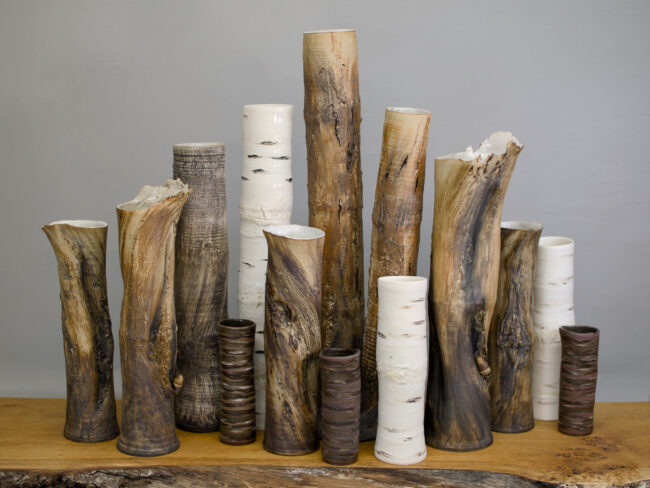
The words we use around handmade ceramics carry meaning. They shape how an object is understood, how it is placed within a home or gallery, and how it is valued. This is why the difference between ceramic vessels and ceramic vases matters to me.

At first, the distinction may seem small. A vase holds flowers. A vessel holds something too. Yet in my own ceramic practice, the word vessel feels more open, more spacious and more aligned with the way I work with clay. A vase often arrives with its function already decided. It is expected to hold stems, sit on a table, and support an arrangement. A vessel, for me, holds wider possibility.

It may hold water. It may hold flowers. It may hold memory, stillness, atmosphere or a connection to nature. It may hold nothing visible at all, while still holding presence within a room.

This is why I often describe my work as ceramic vessels rather than ceramic vases. The word vessel allows the piece to remain alive in meaning. It does not close the object down too quickly.

What is the difference between a ceramic vessel and a ceramic vase?

A vase is usually understood as a container for cut flowers or as a decorative object. This meaning is familiar and useful, especially in domestic language and interior styling. For many people searching online, phrases such as ceramic vase, handmade ceramic vase, sculptural vase or custom ceramic vases for interiors will feel natural.

A vessel carries a broader association. It is still a container, although what it contains is less fixed. The word vessel can refer to bowls, pots, cups, bottles, ceremonial objects, ships and even the body itself through blood vessels. It suggests containment, movement and capacity.

This breadth is important in fine art ceramics. A vessel can refer to form without reducing the work to a single use. It can suggest function while allowing the object to operate as sculpture, memory, gesture or symbolic presence.

In this sense, ceramic vessels versus ceramic vases is not only a question of terminology. It is a question of intention.

Why might a ceramicist have an issue with the word vase?

Some ceramicists and potters are entirely comfortable with the word vase, and there is nothing wrong with that. The vase has a long and beautiful history across cultures, rituals, interiors and collections. It has carried flowers, stories, decoration, status and ceremony for thousands of years.

The concern arises when the word vase becomes too limiting. For a maker working with sculptural ceramic vessels, the term can imply that the object’s purpose is already known. It can suggest a relationship with flowers before the viewer has had the chance to meet the form on its own terms.

For artists working in contemporary fine art ceramics, language can become part of the practice. Calling a piece a vessel may gently ask the viewer to stay with it for longer. It may invite them to notice its surface, weight, opening, shadow, curve and silence before deciding what it is for.

This matters because handmade ceramics often sit between categories. They may be functional, sculptural, decorative, contemplative and collectible at the same time. A vessel can hold that complexity more comfortably.

Craft, fine art and the question of function

The ongoing craft versus fine art discussion has followed ceramics for a long time. Clay has often been associated with utility, domesticity, labour and the hand. These associations are valuable, and they are part of the material’s strength. They also mean that ceramics have sometimes had to work harder to be recognised within fine art contexts.

Historically, craft was often understood through use. A crafted object could be worn, held, served from or lived with. Fine art was more often separated from daily function and placed within galleries, museums and critical discourse. Ceramics unsettles this separation because clay belongs naturally in both places.

A ceramic object can sit on a dining table and in a museum. It can be held in the hand and viewed as sculpture. It can be intimate and conceptually rich. This is one of the reasons I find clay so compelling.

The vessel helps bridge this conversation. It acknowledges the long history of pots, containers and functional forms while allowing the work to move into a more reflective and sculptural space.

It respects craft without being confined by use.

Why Sonya Wilkins uses the word vessel

In my own work, vessel feels truthful because I am interested in what clay can hold beyond function. My research question, Can ceramic vessels become activators for wellbeing?, continues to guide my practice. I am drawn to the possibility that an object made from earth can support a sense of calm, grounding and biophilic connection within a space.

When I create sculptural ceramic vessels, I am not thinking only about what they might physically contain. I am considering how they may influence the atmosphere around them. I am thinking about the relationship between clay, nature and human experience.

A vessel can hold the memory of landscape. It can hold the trace of touch. It can hold the quiet rhythm of making. It can also become a point of stillness within an interior, offering a sense of connection to the natural world.

For interior designers, collectors and galleries, this distinction has practical value too. A sculptural vessel can be placed as a focal point, a grounding presence or a contemplative object. It can be specified within interior projects as ceramic art rather than simply as a vase for flowers. This is particularly relevant when choosing statement ceramics for luxury interiors, commissioning made to order ceramic pieces or selecting collectable ceramic artists whose work carries depth and material presence.

Ceramic vessels as containers of possibility

The phrase container of possibilities feels important to me. It suggests that the work remains open. A ceramic vessel does not need to declare everything at once. It can change in meaning depending on where it is placed, who lives with it and how light moves across it.

In a gallery, the vessel may be read through form, material research and conceptual intent. In a home, it may become part of daily life, quietly encountered in passing. In an interior design project, it may help bring texture, depth and natural presence into a carefully considered space.

This is where the vessel becomes more than an object. It becomes a relationship.

The opening of a vessel is also significant. An opening suggests interiority. It invites the imagination inward. Even when empty, the vessel contains space. That inner space can feel symbolic, holding quiet, breath, memory or possibility.

A vase may be completed by flowers. A vessel can be completed by attention.

Why did the London gallery Vessel choose that name?

The London gallery Vessel offers an interesting point of reflection. Vessel Gallery, founded in Notting Hill in 1999, presents museum-quality sculptural artworks in contemporary art glass, ceramics, metal and wood, and works with collectors, museums, interior designers and corporate projects.

I have not found a published statement explaining the precise reason for the gallery’s name. Even so, the choice feels deeply appropriate within the world it occupies. Vessel is a word spacious enough to hold craft, design, sculpture, interior object, collectable artwork and commission. It does not reduce the work to one material, one function or one setting.

For a gallery showing contemporary craft and sculptural art, vessel is a generous word. It allows the object to be functional, symbolic, formal, architectural or contemplative. It allows glass, ceramic, wood and metal to sit within a shared language of containment and presence.

That is perhaps the quiet strength of the word. It carries ancient associations and contemporary relevance at the same time.

Ceramic vessels for interiors, galleries and collectors

For those searching for ceramic vessels versus ceramic vases, the choice may depend on what kind of relationship they want with the object.

A ceramic vase may be the right word when the purpose is floral display, decoration or styling. A ceramic vessel may be more appropriate when the piece is being chosen for its sculptural quality, material presence and deeper sense of meaning.

This distinction matters for interior designers specifying handmade ceramics in interior projects. It matters for collectors considering a bespoke ceramic sculpture commission. It matters for galleries looking at contemporary ceramic artists in the UK whose work sits within a fine art context.

The vessel creates room for the object to breathe.

In my own practice, this is why I return to the word again and again. A vessel can be strong and quiet. It can be useful and contemplative. It can be empty and full. It can belong to the hand, the home, the gallery and the landscape.

When clay becomes a vessel, it becomes a meeting place between earth, maker, viewer and space.

As you look at ceramic work in your own home or collection, you might ask what the piece seems to hold for you. Is it holding flowers, memory, beauty, stillness or a sense of connection to something deeper?

References
Cambridge Dictionary (2026) ‘Vase’. Cambridge University Press.
Cambridge Dictionary (2026) ‘Vessel’. Cambridge University Press.
Tate (2026) ‘Craft’. Tate Art Terms.
Victoria and Albert Museum (2026) ‘Ceramics’. Victoria and Albert Museum.
Victoria and Albert Museum (2025) ‘Arts and Crafts: an introduction’. Victoria and Albert Museum.
Vessel Gallery (2026) ‘About Vessel Gallery’. Vessel Gallery London.
Vessel Gallery (2026) ‘Vessels’. Vessel Gallery London.

Sculptural Ceramics for Interior Designers

Sculptural Ceramics for Interior Designers

There is a quiet moment that happens when a space begins to feel complete. It is rarely the result of one dominant feature. More often, it emerges through balance, texture and a sense of cohesion that is felt rather than analysed. In my experience, sculptural ceramics can play a meaningful role in this process, not as decoration alone, but as a grounding presence within an interior.

When I create vessels, I am thinking not only about form, but about how that form will live within a space. Ceramic sculptures for interior designers are not simply objects to be placed. They are points of stillness, offering a tactile and visual anchor that can soften or deepen the atmosphere of a room.

How interior designers use ceramic art in spaces

Interior designers often work with a careful layering of materials. Wood, stone, textiles and light are brought together to create harmony and contrast. Ceramic work sits naturally within this palette because it shares an earth-based origin while offering a unique responsiveness to touch and light.

In open plan living spaces, where scale and flow are particularly important, sculptural vases for interiors can help define areas without imposing structure. A well-placed vessel can draw the eye, create a pause point and subtly guide movement through a room. The presence of handmade ceramics introduces variation and nuance that mass-produced objects often lack.

I have noticed that when designers incorporate bespoke ceramic commissions into their projects, the relationship between object and environment becomes more intentional. The piece is not selected to fill a gap, but to resonate with the architecture, the light and the emotional tone of the space.

The role of texture and form in ceramic styling

Texture is often one of the most overlooked elements in interior design, yet it has a profound impact on how a space feels. Clay carries texture in a way that is both visual and tactile. It records movement, pressure and process. When left visible, these qualities invite interaction and slow the pace at which a space is experienced.

Form is equally important. Sculptural ceramic artists often work with curves, asymmetry and organic lines that echo natural growth patterns. These forms can soften rigid architectural features and introduce a sense of fluidity. In luxury interiors, where materials may be refined and controlled, ceramic pieces can bring a gentle counterbalance that feels human and grounded.

For interior designers working on high-end residential or hospitality projects, choosing statement ceramics for luxury interiors often involves considering how a piece interacts with natural light. Glazes, surfaces and edges respond differently throughout the day, creating subtle shifts in tone and presence.

“Clay allows me to hold both structure and softness at once. When a vessel enters a space, it carries that balance with it, offering something that feels both stable and quietly alive.”

Bespoke ceramic commissions and spatial storytelling

There is a particular depth that comes with commissioned ceramic artwork. A bespoke ceramic sculpture commission allows the designer, client and artist to collaborate in shaping something that is specific to a place and its purpose. This might be a site-specific ceramic installation within a hallway, a series of custom ceramic vases for interiors in an open plan setting, or a single focal piece that anchors a room.

In the UK, there is a growing appreciation for commissioned ceramic artwork that reflects both craftsmanship and individuality. Clients are increasingly drawn to made to order ceramic pieces that carry a sense of origin and intention. These works become part of the narrative of the home rather than an addition to it.

For galleries and collectors, this approach aligns with a broader interest in contemporary ceramic artists in the UK who are exploring the intersection of art, material and environment. Sculptural ceramic artists are gaining recognition not only for their technical skill, but for their ability to create work that resonates across both domestic and exhibition contexts.

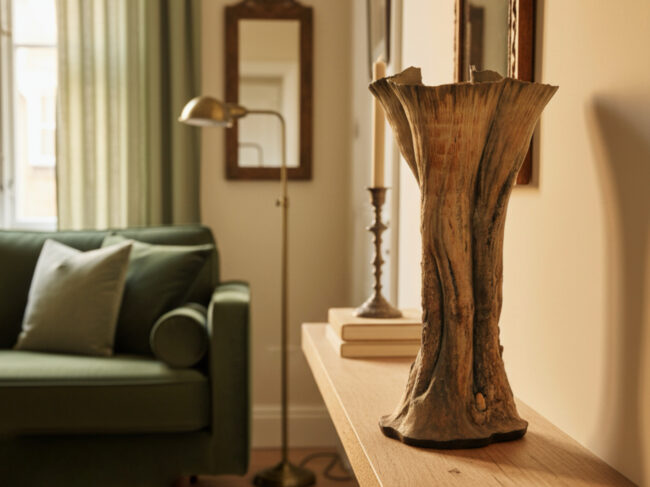
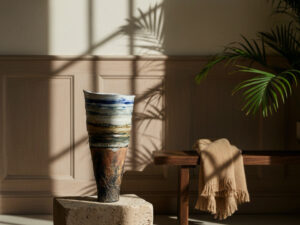
Mighty Oak Tree Vessel By Sonya Wilkins Ceramics 2025
Supporting wellbeing through material presence

There is also a quieter aspect to consider. Materials influence how we feel within a space, often without conscious awareness. Clay, as an earth-derived material, carries associations of stability, grounding and continuity. When introduced into interiors, it can support a sense of calm and presence.

Research into environmental psychology suggests that natural materials contribute to reduced stress and improved wellbeing. The concept of biophilia highlights our innate affinity for elements that connect us to the natural world. Ceramic sculptures for interior designers can support this connection, particularly when their forms and surfaces reflect organic patterns and processes.

In my own practice, I am aware that each piece I create will be encountered daily. It may be seen in passing, touched absentmindedly or simply held within peripheral awareness. These small interactions accumulate. They shape how a space is experienced over time.

“When I create a vessel, I am not only shaping clay. I am considering how it might be lived with, how it might support a moment of pause, or offer a quiet sense of connection within a busy environment.”

Choosing ceramic pieces for contemporary interiors

For designers considering how to specify handmade ceramics in interior projects, there are a few elements that tend to guide the process. Scale, placement and relationship to surrounding materials are key. Larger sculptural pieces can act as anchors within open plan living spaces, while smaller works can create rhythm across shelving, surfaces or transitional areas.

The best ceramic pieces for open plan living spaces are often those that hold their presence without dominating. They invite attention without demanding it. Their value lies not only in visual impact, but in the atmosphere they help to create.

Working with a ceramic artist also allows for flexibility and dialogue. Ceramic artist commissions for interior design projects can respond to specific spatial needs, whether through proportion, colour or form. This collaboration ensures that the final piece feels integrated rather than applied.

As the appreciation for luxury bespoke ceramics in the UK continues to grow, there is an opportunity for interior designers to engage more deeply with material, process and meaning. Sculptural ceramics offer a way to bring these elements into a space with integrity and subtlety.

As you consider the spaces you design or inhabit, you might reflect on how objects influence your sense of calm, focus or connection. What materials support you in feeling grounded, and how might sculptural ceramics contribute to that experience?


References
Pallasmaa, J. (2012) The Eyes of the Skin: Architecture and the Senses. Chichester: Wiley.
Wilson, E.O. (1984) Biophilia. Cambridge, MA: Harvard University Press.
Kellert, S.R. and Calabrese, E.F. (2015) The Practice of Biophilic Design. Available at: www.biophilic-design.com
Malnar, J.M. and Vodvarka, F. (2004) Sensory Design. Minneapolis: University of Minnesota Press.

Sculptural Ceramic Vessels for Interiors

Sculptural Ceramic Vessels for Interiors: Enhancing Aesthetic, Atmosphere and Artistic Value

There is a moment in a well-designed space when everything settles. Light feels considered. Materials sit comfortably together. Nothing is competing. In that moment, a sculptural ceramic vessel does something quite particular. It does not try to dominate. It simply holds its place, and in doing so, it strengthens everything around it.

This is where the work of Sonya Wilkins becomes especially relevant. Her vessels are not created to fill a gap on a shelf or a table. They are made to be part of the structure of a space, shaping how it feels as much as how it looks.

For interior designers, this offers a dependable way to bring depth and balance into a scheme. For gallery owners and curators, it presents a body of work that is consistent, thoughtful and quietly confident.

What Defines a Sculptural Ceramic Vessel in Contemporary Interiors

A sculptural ceramic vessel is rarely about function. It is about presence. The form comes first. The curve, the edge, the weight of the piece in relation to the space around it. Surface follows, often with subtle variations that reveal themselves over time rather than immediately. Light moves across it differently throughout the day. It invites a slower kind of attention.

In Sonya’s work, there is a clear connection to natural form. Shapes feel softened, as though they have been shaped by time rather than tools. Surfaces carry a quiet variation that avoids uniformity. Nothing feels forced. For designers, this creates an object that integrates easily into a considered palette. For curators, it signals a practice grounded in material understanding and intention.

Enhancing Interior Aesthetic Through Form and Placement

Interior designers are often resolving a series of small decisions that collectively define a space. A sculptural ceramic vessel can quietly support several of those decisions at once. Placed in an entrance hall, a larger piece can provide an immediate sense of arrival. It offers a focal point without overwhelming the architecture. In a living space, a vessel can sit within a composition of furniture and materials, adding weight and grounding the arrangement.

Texture plays an important role. Against glass, polished stone or smooth painted surfaces, ceramic introduces a gentle contrast. It brings a layer of material richness that feels natural rather than decorative. Scale is equally important. A well-chosen piece feels proportionate. It neither disappears nor dominates. It simply belongs. This is often what designers are searching for. Not an object that stands apart, but one that completes the space.

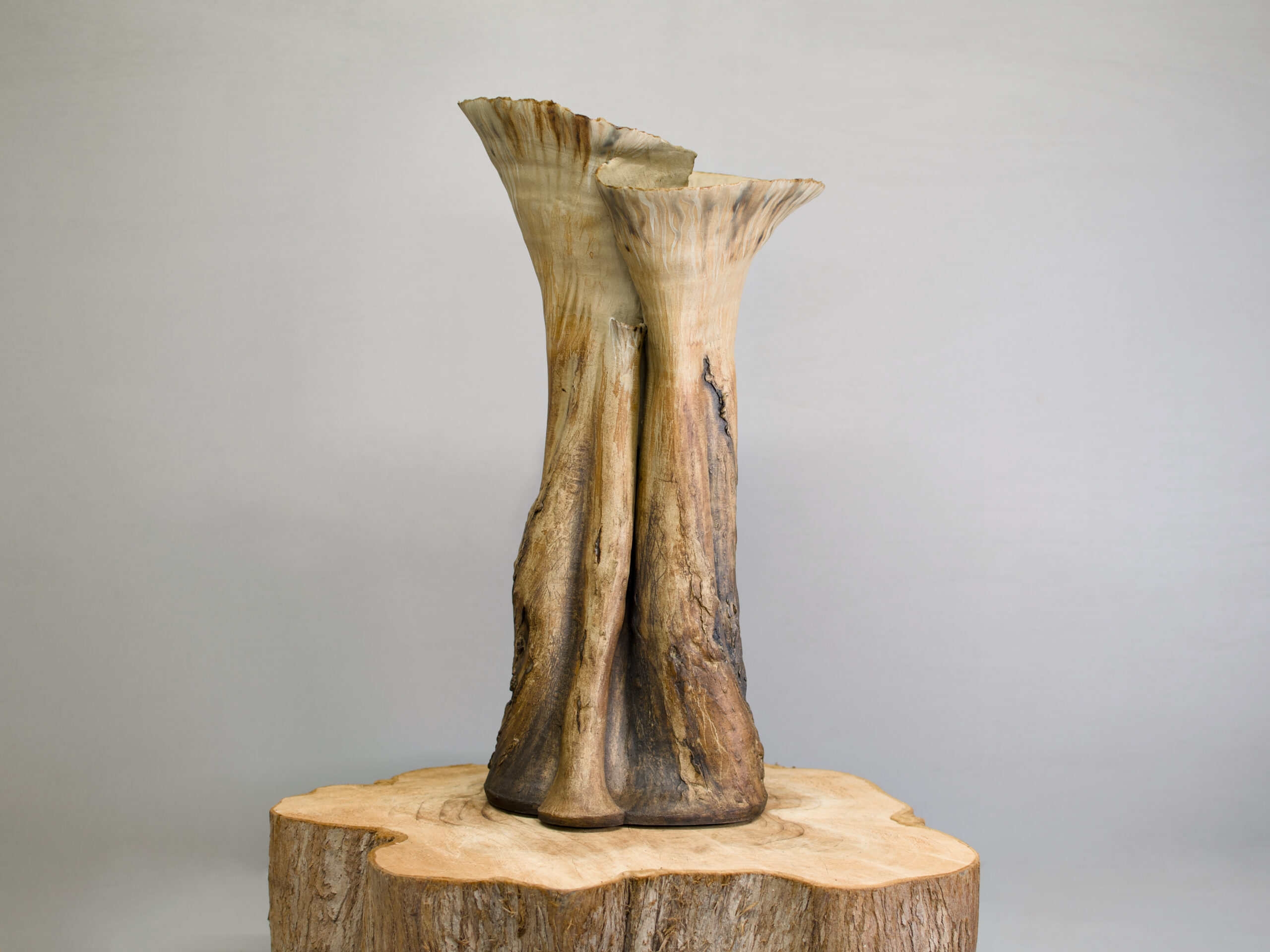
Mighty Oak Tree Vessel By Sonya Wilkins Ceramics 2025

From Object to Artwork: Relevance for Curators and Galleries

In a gallery setting, the same vessel is experienced differently. The context shifts, and so does the attention. Here, the focus is on the work itself. The decisions behind it. The consistency of the forms. The relationship between pieces when seen together.

Sonya Wilkins’ work translates naturally into this environment. There is a recognisable language across her vessels. The forms are distinct yet connected. The surfaces carry evidence of process without feeling unfinished.

For curators, this creates a clear narrative. The work can sit within wider conversations around material, landscape and contemporary ceramic practice. It holds its own, without needing explanation. For collectors, there is a sense of continuity. Each piece feels part of something larger, rather than a one-off object without context.

The Value of Bespoke Ceramic Commissions in Interior Projects

There is a particular satisfaction in placing something within a space that has been made specifically for it. Bespoke ceramic commissions allow for that level of consideration. Scale can be adjusted. Form can respond to architectural features. The piece can be developed with the space in mind from the beginning.

For interior designers, this offers control and clarity. The final result aligns with the overall scheme rather than being adapted to fit. For the artist, it provides an opportunity to engage more deeply with context. The work becomes part of the space rather than an addition to it. For the client, the outcome is something that cannot be replicated. A piece that carries both aesthetic value and a sense of permanence.

Why Sculptural Ceramics Continue to Matter

There is a growing preference for materials that feel real, considered and lasting. In that context, sculptural ceramics have a quiet relevance. They are not trend-led. They do not rely on colour or pattern to make an impression. Instead, they offer form, texture and material integrity. Over time, this becomes more important. The piece remains, even as other elements within a space change.

A Natural Fit Across Interior Design and Contemporary Art

For interior designers, Sonya Wilkins’ vessels provide a way to complete a space with balance and subtle confidence. They support the overall aesthetic without competing for attention.

For gallery owners and curators, the same work offers a coherent and collectable ceramic practice. It carries consistency, material understanding and a clear sense of intent.

In both contexts, the vessels do more than occupy space. They shape how it is experienced.

Creating in Presence

Creating in Presence

“The key to spiritual growth and freeing ourselves from this worldly thinking is realising that it is the presence with which we do something that matters, not what we do.”
Hollie Holden, ACIM

This sentence has stayed with me for some time. It feels simple, yet it asks something profound of us. It suggests that transformation is not located in achievement, productivity or visibility, but in the quality of attention we bring to each moment.

In my own life, this has become most apparent in the studio.

When I enter the space where I work with clay, there is always the temptation to think about outcomes. What will this piece become? Will it be well received? Does it align with a collection? Those thoughts arise easily. They are part of living in a world that measures and evaluates.

Yet I have learned that when I create from that place alone, something feels slightly disconnected. The work may be technically sound, but it lacks depth. It is only when I soften my focus and return to presence that the clay begins to respond differently.

Presence, for me, begins with the body. I notice my breath. I feel the weight of the clay in my hands. I sense the temperature of the studio, the texture of the surface beneath my fingertips. These small acts of attention anchor me. They draw me away from mental projection and into immediate experience.

In this state, the making becomes less about producing and more about listening.

Clay is honest. It does not respond well to force or distraction. If I am unsettled, it shows in the tension of the form. If I am calm and attentive, the vessel often carries a quiet steadiness. This is not mystical. It is relational. The material mirrors the energy with which it is handled.

The quotation from Hollie Holden resonates because it reflects what I experience daily. Spiritual growth, in my understanding, is not separate from ordinary life. It is not confined to meditation cushions or retreats. It is expressed in how I shape a rim, how I smooth a surface, how I pause before altering a curve.

The presence I bring to these actions changes the quality of the outcome, yet it also changes me.

There is research to support the value of this kind of attentive engagement. Studies in mindfulness and contemplative practice show that sustained, non-judgemental awareness of present-moment experience can reduce stress, enhance emotional regulation and support neural integration. Activities that involve repetitive, tactile focus, such as working with clay, naturally invite this state. They slow mental rumination and encourage embodied awareness.

I notice that when I create in presence, time feels different. It expands. The pressure to complete fades. What remains is a gentle concentration that feels nourishing rather than depleting. Even if the piece does not survive the kiln, the time spent with it has already offered something valuable.

This understanding has gradually extended beyond the studio.

When I am with a Reiki client, the same principle applies. The techniques matter, yet what truly shapes the session is the quality of attention I bring. Am I fully there, or am I subtly preoccupied? Clients often sense the difference before I do. Presence is palpable.

The same is true in nature. When I walk among trees, I can choose to think through problems or I can allow myself to simply experience the movement of light, the sound of leaves, the texture of ground underfoot. The latter shifts something inside me. It feels as though the boundary between inner and outer softens.

Creating in presence becomes a practice of freedom. It frees me from the need to measure every action against an imagined future. It frees me from the belief that worth is located in visible results. It brings me back to the simplicity of this moment, this breath, this touch of clay.

There are days when I forget. I move too quickly. I compare. I strive. On those days, the work feels heavier. Returning to presence is rarely dramatic. It is often as small as placing my hands on the clay and pausing long enough to feel its quiet solidity.

In that pause, something opens.

The world encourages us to focus on what we are doing and how it appears. Presence asks a different question. How are we being while we do it?

When I shape a vessel from this place, I sense that it carries more than form. It carries the quality of attention with which it was made. Perhaps this is why certain objects feel calm or grounding in our homes. They hold the residue of presence.

As you reflect on your own creative or daily practices, you might ask yourself where your attention rests. Is it ahead of you, measuring and anticipating, or is it here, in the texture of what you are touching right now?

The invitation is gentle. It is not to change what you do, but to notice how you are while you do it.

Privacy Settings
We use cookies to enhance your experience while using our website. If you are using our Services via a browser you can restrict, block or remove cookies through your web browser settings. We also use content and scripts from third parties that may use tracking technologies. You can selectively provide your consent below to allow such third party embeds. For complete information about the cookies we use, data we collect and how we process them, please check our Privacy Policy
Youtube
Consent to display content from - Youtube
Vimeo
Consent to display content from - Vimeo
Google Maps
Consent to display content from - Google