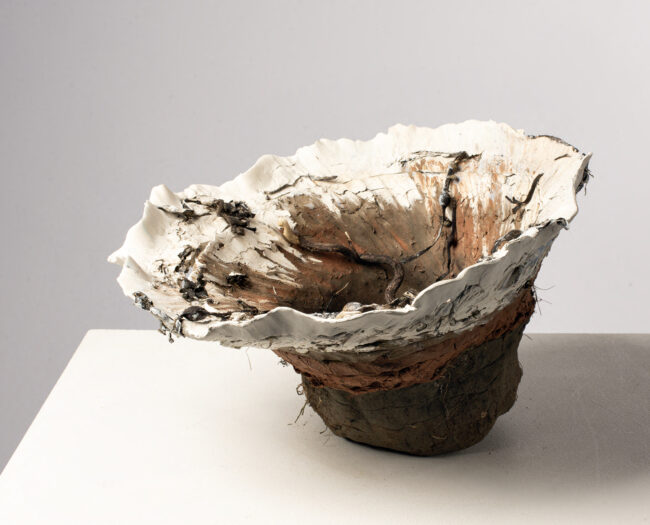
Wild Clay in Contemporary Ceramics

Wild Clay in Contemporary Ceramics: Foraging, Place and the Story Held in the Earth

There is something deeply grounding about knowing where clay has come from.

Most ceramic clay arrives in the studio prepared, consistent and ready to use. Wild clay begins somewhere very different. It may appear in an exposed bank, beneath a field, beside a stream or within the changing geology of a familiar landscape. Gathering it creates a direct relationship between the place I am experiencing and the material that eventually reaches my hands.

For me, this is what makes wild clay in contemporary ceramics so compelling. The material carries a genuine physical connection with landscape. Its colour, mineral content, texture and firing behaviour have developed through geological processes that began long before I arrived to work with it.

When I incorporate wild foraged clay into my ceramic practice, I feel that the landscape has become an active participant in the work.


What is wild clay?

The term wild clay generally describes clay gathered directly from the landscape and used with little or no industrial processing. In one sense, all ceramic clay begins as a natural geological material. The difference lies in what happens between the earth and the studio.

Commercial ceramic bodies are usually refined and blended to create predictable properties. A wild clay retains more of its local character. It may contain iron, sand, fine stones, organic matter and differing proportions of clay minerals such as illite, kaolinite or smectite.

British Geological Survey research shows how considerably these mineral compositions can vary between formations and even within the same geological sequence. Parts of Somerset, for example, include Lias Group clays and mudstones formed approximately 180 to 205 million years ago.

This means that local clay for ceramics is genuinely local. Two clays gathered from relatively nearby places may behave very differently in the hand and in the kiln.


Why do ceramic artists forage for clay?

My attraction to foraging clay begins with connection rather than convenience.

Gathering a small amount of clay from a place I know changes the way I understand the material. I become more aware of the ground beneath me, the geology that shaped the landscape and the length of time contained within something I might otherwise simply call clay.

There is also uncertainty in working this way. Wild clay may be highly plastic, sandy, coarse or surprisingly smooth. It may fire red, brown, buff or almost black depending upon its mineral content and firing atmosphere. This unpredictability requires listening.

Before using a newly gathered clay within finished work, ceramic artists commonly process and test small quantities to understand shrinkage, colour, texture and firing behaviour. Research into ceramic materials confirms that mineral composition, organic matter, firing temperature and atmosphere all influence what happens as clay transforms permanently into ceramic.

“Wild clay asks me to begin with curiosity. I have to discover what the material is capable of rather than deciding everything for it in advance.”


Clay as a record of place

This relationship with geology sits naturally within my wider practice of nature-inspired ceramics.

My work often begins through walking, observing and spending time with a particular landscape. Trees, woodland floors, exposed earth and natural formations become part of my visual and sensory memory. Wild clay allows the landscape to enter the work at another level because the place itself becomes material.

Sometimes I use wild clay alongside commercial clay rather than creating an entire vessel from it. It might become a surface, a slip, an inclusion or part of a wider material conversation. The distinction matters less to me than the relationship it creates.

A vessel containing clay gathered from a landscape carries something physical from that location. The connection is geological as well as conceptual.


Is wild clay more sustainable?

Wild clay is sometimes described as a sustainable ceramic material, although I think this deserves care. Gathering locally can reduce some processing, packaging and transportation associated with commercial materials. Small-scale use can also encourage makers to understand where their raw materials originate. Ceramic making still involves energy-intensive kiln firing, and removing material from landscapes carries its own responsibilities.

For me, responsible clay foraging means taking only small amounts, gathering with permission and considering the sensitivity of the place. Protected habitats, geological sites and private land require particular respect.

My Carbon Literacy training has encouraged me to think about environmental responsibility throughout my studio practice rather than attach a simple sustainable label to one material. Wild clay helps me become more conscious of material origin, which is valuable in itself.


Wild clay and contemporary sculptural ceramics

There is a beautiful tension between ancient material and contemporary ceramic art.

Humans have made objects from locally available clay for thousands of years. British pottery traditions themselves grew around geology, access to clay and fuel. British Geological Survey records show how the historic Stoke-on-Trent industry initially relied upon local clays before ceramic manufacture increasingly incorporated materials transported from elsewhere.

Working with wild clay therefore connects contemporary ceramic practice with a very old relationship between making and place.

Within my own sculptural ceramic vessels, this connection is particularly important. I am interested in clay acting as a bridge between human experience and the natural world. Wild clay makes that bridge tangible.

The material itself has already belonged to somewhere.

“Working with wild clay reminds me that I am never beginning with a blank material. The earth has already given it colour, texture, history and character long before it reaches my hands.”


Living with ceramics that carry a landscape

When a handmade ceramic vessel moves into a home, its relationship with place continues in another form.

A surface created with locally gathered clay may contain subtle variations that could never be completely replicated. These differences are part of the material’s identity. For collectors and interior designers seeking sculptural ceramics, bespoke ceramic commissions or handmade objects with a strong sense of provenance, this gives the work another layer of meaning.

The vessel can become a quiet reminder that the objects around us have origins. Materials come from somewhere, and knowing something of that story can deepen our connection with the things we choose to live with.

You are invited to explore my Collections, where nature, landscape and material are woven throughout the ceramic vessels I create. For enquiries about available work or a bespoke ceramic commission, please visit the Contact page.

Perhaps next time you walk across a familiar landscape, consider what may be beneath your feet. What histories, colours and possibilities might the earth be quietly holding?


References
British Geological Survey (2026) ‘Lias Group’. Keyworth: British Geological Survey.
British Geological Survey (2026) ‘Industrial minerals planning’. Keyworth: British Geological Survey.
Fishman, M. (2022) ‘Wild Clay and Glaze’, Ceramics Monthly. Westerville, OH: The American Ceramic Society.
Jordanova, N. et al. (2012) ‘Pottery firing temperatures: a new method for determining the firing temperature of ceramics and burnt clay’, Journal of Archaeological Science, 39(11), pp. 3473–3480.
Maritan, L. et al. (2006) ‘Influence of firing conditions on ceramic products: Experimental study on clay rich in organic matter’, Applied Clay Science, 31(1–2), pp. 1–15.
Ceramic Review (2025) ‘Masterclass: Wild Clay’. London: Ceramic Review.
Art for Wellbeing

Art for Wellbeing

Art has always been part of how I understand myself and the world around me. Through dance, healing work and ceramics, creativity has given me somewhere to place attention, emotion and energy. Over time, I have become increasingly interested in art for wellbeing, both through the way making supports my own sense of balance and through the possibility that an artwork can offer something meaningful to the person who eventually lives with it.

For me, wellbeing through art begins with presence. When my hands meet clay, attention settles into something tangible. I notice pressure, temperature, moisture and movement. Thoughts become quieter as the material asks me to stay with what is happening in front of me.

This quality of attention is one of the reasons clay has become such an important part of my own wellbeing.


How does making art support wellbeing?

Research increasingly recognises a relationship between creative activity and wellbeing. The World Health Organization reviewed more than 3,000 studies examining arts and health and found evidence for the role of arts engagement in health promotion, prevention and the management of a range of health conditions.

One small study from Drexel University also found that 45 minutes of art-making was associated with a significant reduction in cortisol, a hormone involved in the stress response, across a group of healthy adults. Participants used materials including modelling clay, collage and drawing materials, and previous artistic experience did not appear to determine the response.

These findings interest me because my own experience of making is deeply physical. Working with clay brings me into my hands and back towards my body. The process has weight and resistance. I cannot stay entirely inside my thoughts because the material continually asks me to respond.

“Clay gives my attention somewhere to rest. When I become absorbed in making, I often feel myself returning to a steadier and more grounded place.”


Clay and wellbeing in my own creative practice

There are days when I arrive in the studio carrying the residue of everything else happening in life.

I may feel tired, emotionally full or mentally scattered. I rarely expect clay to provide an instant solution. What it gives me is a way of becoming present with myself.

Throwing has rhythm. Carving asks for concentration. Hand-building slows the movement of my hands. Even preparing clay creates repetition that can feel reassuring.

My work with nature deepens this process further. Walking among trees, observing bark, collecting memories of landscapes and sometimes working outside all influence the vessels I eventually make. The relationship between nature, clay and wellbeing has become central to my artistic research.

Research into nature connectedness has found a positive association with wellbeing, including positive emotion, vitality and life satisfaction. This feels familiar to me because my most restorative experiences often involve both making and nature. The two seem to speak the same language of attention.


Can ceramic art support wellbeing for others?

My MA in Fine Art Ceramics explored the question: Can ceramic vessels become activators for wellbeing?

I remain curious about this rather than treating it as something conclusively answered. A ceramic vessel is not a treatment, and I do not claim that owning an artwork produces a particular health outcome. My interest lies in the relationship people develop with objects, materials and spaces.

A handmade vessel can invite touch. Its surface may remind someone of bark, stone, earth or a familiar landscape. Its form may create a moment of stillness within a room. Someone may simply enjoy seeing it in changing morning and evening light.

These experiences matter because wellbeing can also be supported through ordinary moments of connection, attention and meaning.

This is where I see ceramic art for wellbeing becoming particularly interesting. The artwork does not need to ask anything of the person living with it. It can remain quietly present and available to be noticed.


Nature-inspired ceramics and a sense of connection

Much of my work develops from biophilic connection, our human relationship with the natural world. Tree Vessels, Earth Vessels and Landscape Vessels carry traces of environments I have spent time observing and experiencing.

I am interested in translation rather than literal representation. Bark may become texture. The movement of branches may influence a form. Wild clay may bring the physical geology of a particular place directly into the vessel.

When one of these pieces moves from my studio into somebody’s home, the relationship changes again. The vessel begins to belong to another environment and another person.

“My wellbeing is woven into the act of making, and my hope is that something of that attention and connection travels with the finished piece into the life of someone else.”


Art for wellbeing within the home

The objects we choose to surround ourselves with contribute to the character of our interiors.

Handmade art carries evidence of time, human touch and material transformation, creating a very different presence from something produced anonymously and repeatedly.

For collectors and interior designers, nature-inspired sculptural ceramics can bring texture, organic form and a connection with earth-derived materials into a space. For the individual living with a piece, the relationship can become personal over time.

A vessel may mark a significant moment, remind someone of a landscape they love, or simply become an object they enjoy pausing beside each day.

For me, this is where art and wellbeing meet most naturally. The value sits within relationship, presence and experience.

You are invited to explore my Collections and notice how the different vessels make you feel.

Perhaps spend a little longer with the forms that hold your attention.

Which pieces bring you a sense of connection, stillness or recognition, and what might that tell you about the kind of art you want to live with?


References
Capaldi, C.A., Dopko, R.L. and Zelenski, J.M. (2014) ‘The relationship between nature connectedness and happiness: a meta-analysis’, Frontiers in Psychology, 5, article 976.
Fancourt, D. and Finn, S. (2019) What is the evidence on the role of the arts in improving health and well-being? A scoping review. Copenhagen: WHO Regional Office for Europe.
Kaimal, G., Ray, K. and Muniz, J. (2016) ‘Reduction of cortisol levels and participants’ responses following art making’, Art Therapy, 33(2), pp. 74–80.
Nan, J.K.M. and Ho, R.T.H. (2017) ‘Effects of clay art therapy on adults outpatients with major depressive disorder: A randomized controlled trial’, Journal of Affective Disorders, 217, pp. 237–245.
Pallasmaa, J. (2012) The Eyes of the Skin: Architecture and the Senses. Chichester: Wiley.

How Passion Shapes My Creative Practice

From Dance to Clay: How Passion Shapes My Creative Practice

Passion has always moved through my life as a form of energy. It has changed shape over time, finding different languages through the body, through movement, through touch and now, through clay. When I look back, I can see a thread running from my early passion for dance into my contemporary ceramic practice. The material has changed, yet the impulse feels familiar. It is still about rhythm, presence, expression and the deep need to create from somewhere honest.

Dance taught me that the body knows things before the mind can explain them. It taught me to listen through movement, to feel direction, weight, balance and pause. These same qualities now sit quietly within my work as a ceramic artist. When I am shaping clay, I often feel that I am still dancing in some way, only the movement has become smaller, slower and held within my hands.

How does passion shape creative practice?

Passion is often spoken about as intensity, although I experience it more as devotion. It is the willingness to return again and again to something that continues to call you. In creative practice, passion is not always dramatic. It can be steady, patient and deeply grounding.

Research into creativity and motivation often distinguishes between different kinds of passion. Harmonious passion, where a person engages with an activity freely and with a sense of alignment, has been associated with wellbeing, persistence and creative fulfilment. This feels true to my own experience. The passion that sustains my work is not about striving. It is about relationship.

Clay asks for this kind of relationship. It cannot be rushed without consequence. It responds to pressure, moisture, temperature and timing. If I bring too much force, the form tells me. If I am distracted, the clay records it. Passion, in this context, becomes a quality of attention rather than a push towards outcome.

From passion in dance to passion in clay

Dance gave me an early understanding of how energy moves. A gesture can be strong or delicate. A pause can hold as much meaning as movement. Space is never empty, because the body is always in relationship with it.

When I began to return more deeply to clay, I realised that these lessons had not left me. They had simply been waiting for another material. Throwing and reforming a vessel involves rhythm. The hands move in response to the turning wheel, the breath settles into the process and the body learns when to apply pressure and when to soften.

This is one of the reasons I feel drawn to sculptural ceramic vessels. They allow movement to remain visible. A curve, a slight asymmetry, a textured surface or a lifted edge can hold the memory of gesture. These marks are not accidental. They are part of the life of the piece.

In dance, the body expresses what words cannot always reach. In clay, the vessel can do the same.

Why clay became my creative language

Clay is earth held in the hands. It carries the memory of place, water, minerals and time. As my practice has evolved, especially through my MA in Fine Art Ceramics and my research into whether ceramic vessels can become activators for wellbeing, I have come to understand clay as more than a medium. It is a conduit.

My nature-inspired ceramics are shaped through walking, observing, sensing and remembering. Sometimes the starting point is a tree, a forest floor, a leaf structure, a stone surface or the feeling of being held by the landscape. These experiences move through me and return later in the studio as form.

This is where passion and presence meet. The work is not about copying nature. It is about allowing a response to emerge through the material. Clay gives that response a body.

Can handmade ceramics hold emotion?

I believe handmade ceramics can hold the quality of their making. A vessel created in haste carries a different feeling from one shaped through stillness and care. This may be subtle, but many people sense it when they encounter a piece.

There is a reason we are drawn to handmade objects. They remind us of touch, time and human presence. In a world where many things are manufactured quickly and uniformly, handmade ceramic vessels offer a different kind of experience. They invite the eye to slow down and the body to notice.

For interior designers, collectors and galleries, this is part of the value of sculptural ceramics. A piece can bring more than visual interest to a space. It can offer atmosphere, texture and a quiet sense of connection. This is why ceramic sculptures for interior designers, bespoke ceramic commissions and collectable ceramic artworks can carry such resonance within homes, galleries and carefully designed interiors.

Passion as a form of listening

As I grow older, I am less interested in passion as urgency and more interested in passion as listening. What continues to call me? What do I return to without needing to be persuaded? What brings me back into myself?

Clay does this for me. Nature does this for me. Healing work does this for me. They are not separate strands of my life, but connected expressions of the same deeper impulse. Each asks me to be present. Each reminds me that creativity is not only what we make, but how we meet the moment of making.

The passion that once moved through dance now moves through my hands into clay. It is quieter, perhaps, but no less alive. It has become part of how I understand my own path as a contemporary ceramic artist in the UK, creating work that explores nature, wellbeing and the human need for connection.

“My creative practice has always been guided by feeling first. Dance taught me to listen through the body, and clay continues to teach me how that listening can become form.”

Living with objects made through passion and presence

When a vessel leaves my studio, I hope it carries something of this process with it. I hope it becomes more than an object within a room. I hope it offers a moment of pause, a reminder of nature, and a quiet connection to the hands and presence that shaped it.

For those drawn to handmade ceramic vessels, sculptural ceramics or bespoke ceramic commissions, the invitation is often personal. A piece may speak through texture, form, colour or simply through the feeling it brings into a space.

You are invited to explore the Collections and notice which pieces resonate. If you feel drawn to discuss a commission or a particular work, the Contact page offers a simple way to begin that conversation.

As you reflect on your own life, you might ask where passion has quietly followed you. What has changed form over time, yet remained true at its centre?


References
Csikszentmihalyi, M. (1996) Creativity: Flow and the Psychology of Discovery and Invention. New York: HarperCollins.
Ingold, T. (2013) Making: Anthropology, Archaeology, Art and Architecture. London: Routledge.
Pallasmaa, J. (2012) The Eyes of the Skin: Architecture and the Senses. Chichester: Wiley.
Vallerand, R.J. et al. (2003) ‘Les passions de l’âme: On obsessive and harmonious passion’, Journal of Personality and Social Psychology, 85(4), pp. 756–767.

Clay My Catalyst

Clay ~ My Catalyst, Conduit and Life Companion

When I look back over my life, I can see that clay was quietly present, long before I could articulate what it was, or what it would activate within me. It wasn’t a conscious career choice or a material discipline, but something more intimate; a catalyst for my self development, a conduit through which I could ‘speak’ – essentially a life companion.

One of my earliest memories is fossil hunting with my father. I was very young, barely able to hold the weight of the stones we carried home, yet utterly captivated by the moment of discovery. Cracking open a nondescript rock to reveal the spiral geometry of an ammonite, felt like uncovering a secret held patiently by the earth. Around the same time, I would help my father in the garden, digging into heavy clay soil as he planted trees. My hands learned the resistance and generosity of the ground, the way earth yields only when approached with effort and care. These were not creative acts in the conventional sense, but they formed a quiet apprenticeship in listening to the land.

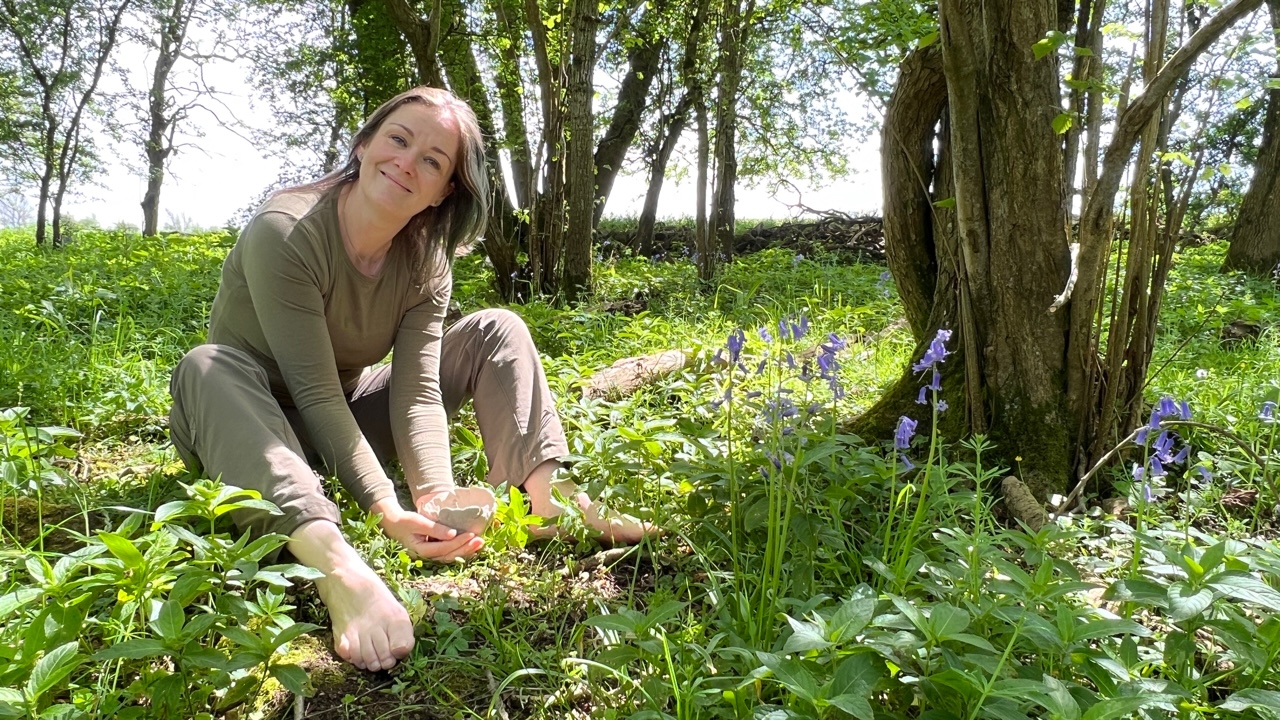
Nature became a constant companion as I grew; walking through bluebell woods, often with our dogs at my side; I was taught to slow down, to notice, to commune rather than consume. These walks were not about destination, they were about attunement; light filtering through leaves, the smell of damp soil, the sound of wind moving through branches. Long before I encountered the language of wellbeing or forest bathing, my body understood that something essential was being restored in these spaces.

Biophilia Connection

My first formal meeting with clay came at junior school, and the recognition was immediate. There was an ease and familiarity in my hands that surprised me, and this amazing ‘mud’ allowed me to mould anything that came to my playful mind. My first creations – two pairs of owls and cats, still sit on my studio window cil today – two ears missing from the trials of life, but happy reminders of that poignant meeting.

Clay did not feel like a new material, it felt like a continuation, and that instinctive connection guided my decision to study ceramics for my BA (Hons) at Bristol Bower Ashton Polytechnic. At that stage, I could not have articulated why clay mattered so deeply, only that it did, and somehow, everything became alright when I touched it.

Years later, in 2011, I trained as a crystal therapist. This marked a turning point in my understanding of materials and energy. Through that training, I became acutely aware that the minerals used in healing practices were the same minerals that form clay bodies and glazes, such as quartz, and feldspar. What I had previously experienced intuitively, now had a conceptual framework. Clay was not simply earth shaped by hand. It was a complex mineral system with energetic properties, capable of holding, transmitting and transforming energy; and what’s more, the intention of the maker. At this point, I realised I was the conduit in the energy transfer between my flesh and bones and clay.

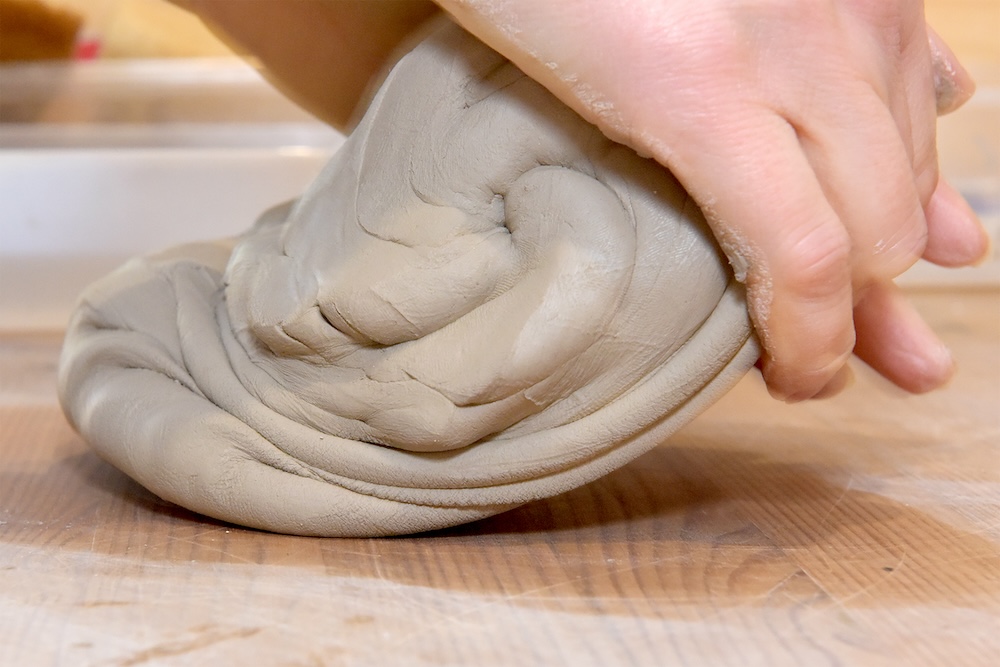
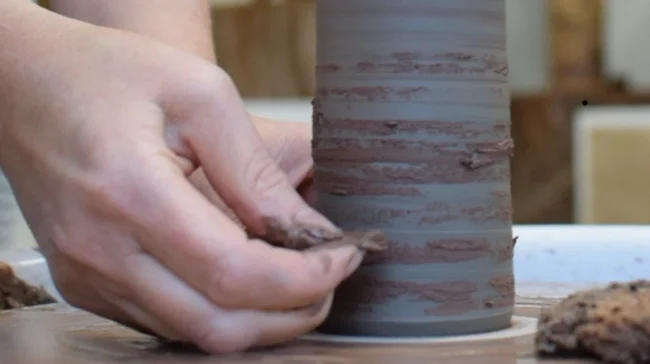
Wedging Clay

In 2013, life offered me a moment of profound circularity. I was invited to become the ceramics specialist at Clifton High School, the very place where I had first encountered clay as a child in junior school. On my first day, while exploring the ceramics studio, I found a shoebox of old photographs on a shelf. On the top was an image of me as a student, standing beside my early ceramic work – serendipity in motion. Shortly afterwards, I opened a fresh bag of clay and the sensation was overwhelming. It felt like greeting an old friend after many years apart. There was no sense of picking up where I had left off- rather, it felt like coming home.

By 2016, I committed to ceramics as a professional practice. This decision later coincided with a deeper questioning of why I make and what my work offers beyond form and surface. These questions became central to my MFA in 2023, titled ‘Can Ceramic Vessels Become Activators for Wellbeing?’. Alongside this research, I studied forest bathing, exploring the physiological and psychological effects of immersive nature experiences. What became clear was that my practice was no longer about objects alone. It was about the relationship between body and material; between human and landscape; between inner and outer worlds.

Haven

My tree vessels emerged from this period of inquiry. Their origin can be traced to a series of journeys home from Bath University during my MFA. Driving at dusk, I became mesmerised by the dramatic bare tree formations silhouetted against the setting sun. Their reaching branches gesturing to rising energy, resilience, shelter and transformation.

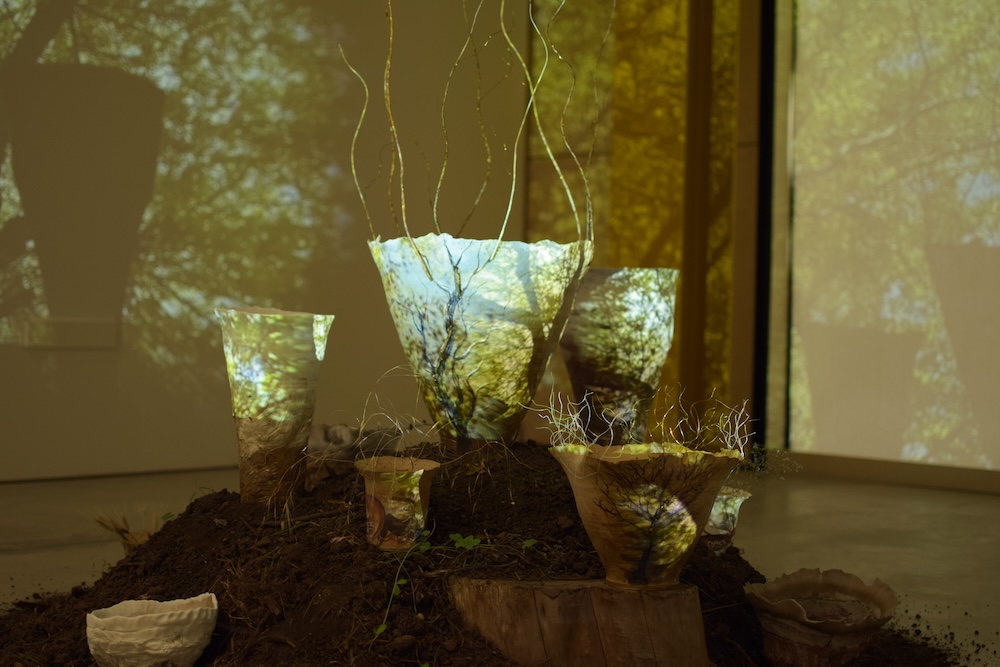
From this experience, ‘Haven’ was born – a multi-sensory installation composed of ceramic and raw clay vessels ‘unearthed’ from nature; nestled in a mound of living earth, while tree projections danced over their surfaces, woven willow reached for the sky and whispering sounds spoke to the spirit of the trees. Forest aromas were also offered in meditation bowls to activate the senses and invite harmonious balance. The intention was to create a space where viewers could reconnect with a sense of belonging and ‘biophilia’ that is often lost in contemporary life.

Today, my practice continues to evolve around this idea of translation and remembrance. My ‘Earth Vessels’, made on location, translate the power of the four elements, holding space for reflection and accountability within fine art installations; whereas my ‘Tree Vessels’ and ‘Landscape Vessels’ are intended for the home as rememberings for your soul. My newest vessels are my ‘Palo Santo Wood Burners’ which mimic the beauty of tree trunks, while allowing sacred wood to burn in dwelling spaces, bringing the healing quality of nature inside, to raise wellbeing.

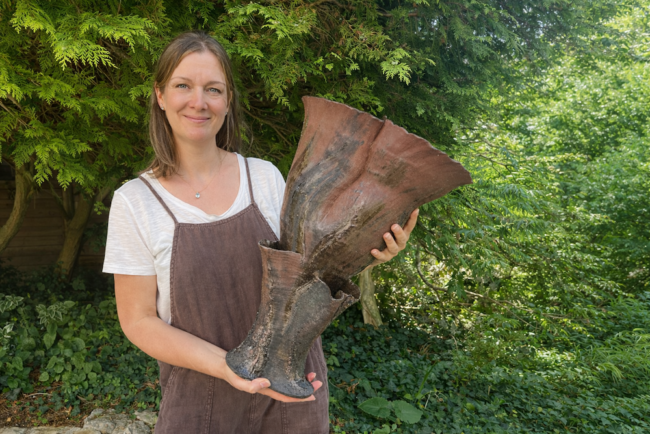
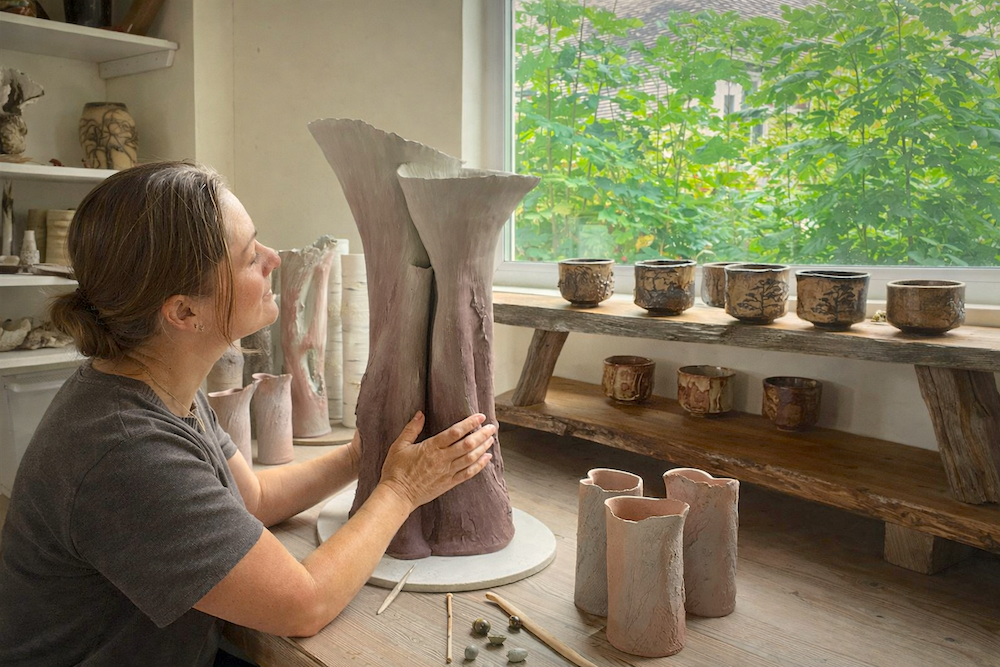
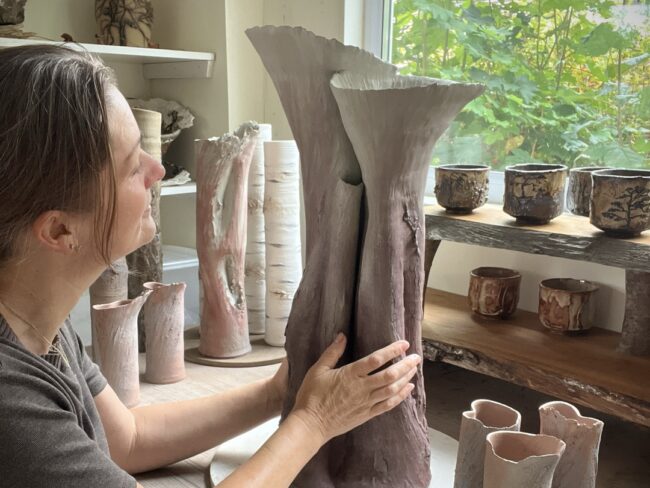
Sonya Wilkins touching a newly made ceramic tree vessel in raw clay, in her studio, showing intimate connection to clay as her making medium

Clay remains my catalyst for self-development, my conduit for wellbeing and my trusted companion. Through it, I continue to explore what it means to belong, to listen and to come home. Next time your hands touch clay, what does it whisper to you? How can it help you come home?

To explore more about my two worlds of ceramic art and wellbeing, visit www.sonyawilkins.com and follow my creative practice on Instagram. 

Creating in Presence

Creating in Presence

“The key to spiritual growth and freeing ourselves from this worldly thinking is realising that it is the presence with which we do something that matters, not what we do.”
Hollie Holden, ACIM

This sentence has stayed with me for some time. It feels simple, yet it asks something profound of us. It suggests that transformation is not located in achievement, productivity or visibility, but in the quality of attention we bring to each moment.

In my own life, this has become most apparent in the studio.

When I enter the space where I work with clay, there is always the temptation to think about outcomes. What will this piece become? Will it be well received? Does it align with a collection? Those thoughts arise easily. They are part of living in a world that measures and evaluates.

Yet I have learned that when I create from that place alone, something feels slightly disconnected. The work may be technically sound, but it lacks depth. It is only when I soften my focus and return to presence that the clay begins to respond differently.

Presence, for me, begins with the body. I notice my breath. I feel the weight of the clay in my hands. I sense the temperature of the studio, the texture of the surface beneath my fingertips. These small acts of attention anchor me. They draw me away from mental projection and into immediate experience.

In this state, the making becomes less about producing and more about listening.

Clay is honest. It does not respond well to force or distraction. If I am unsettled, it shows in the tension of the form. If I am calm and attentive, the vessel often carries a quiet steadiness. This is not mystical. It is relational. The material mirrors the energy with which it is handled.

The quotation from Hollie Holden resonates because it reflects what I experience daily. Spiritual growth, in my understanding, is not separate from ordinary life. It is not confined to meditation cushions or retreats. It is expressed in how I shape a rim, how I smooth a surface, how I pause before altering a curve.

The presence I bring to these actions changes the quality of the outcome, yet it also changes me.

There is research to support the value of this kind of attentive engagement. Studies in mindfulness and contemplative practice show that sustained, non-judgemental awareness of present-moment experience can reduce stress, enhance emotional regulation and support neural integration. Activities that involve repetitive, tactile focus, such as working with clay, naturally invite this state. They slow mental rumination and encourage embodied awareness.

I notice that when I create in presence, time feels different. It expands. The pressure to complete fades. What remains is a gentle concentration that feels nourishing rather than depleting. Even if the piece does not survive the kiln, the time spent with it has already offered something valuable.

This understanding has gradually extended beyond the studio; when I am with a Reiki client, the same principle applies. The techniques matter, yet what truly shapes the session is the quality of attention I bring. Am I fully there, or am I subtly preoccupied? Clients often sense the difference before I do. Presence is palpable.

The same is true in nature. When I walk among trees, I can choose to think through problems or I can allow myself to simply experience the movement of light, the sound of leaves, the texture of ground underfoot. The latter shifts something inside me. It feels as though the boundary between inner and outer softens.

Creating in presence becomes a practice of freedom. It frees me from the need to measure every action against an imagined future. It frees me from the belief that worth is located in visible results. It brings me back to the simplicity of this moment, this breath, this touch of clay.

There are days when I forget. I move too quickly. I compare. I strive. On those days, the work feels heavier. Returning to presence is rarely dramatic. It is often as small as placing my hands on the clay and pausing long enough to feel its quiet solidity.

In that pause, something opens.

The world encourages us to focus on what we are doing and how it appears. Presence asks a different question. How are we being while we do it?

When I shape a vessel from this place, I sense that it carries more than form. It carries the quality of attention with which it was made. Perhaps this is why certain objects feel calm or grounding in our homes. They hold the residue of presence.

As you reflect on your own creative or daily practices, you might ask yourself where your attention rests. Is it ahead of you, measuring and anticipating, or is it here, in the texture of what you are touching right now?

The invitation is gentle. It is not to change what you do, but to notice how you are while you do it.

Clay, Trees and the Art of Listening to What Lifts You

Recording the recent episode of An Art To It was an invitation to articulate what has shaped my creative life and my practice as both a maker and someone who cares deeply about human wellbeing in relation to the natural world. I spoke with Elaine Dye about the threads that have woven together my journey, from early encounters with art to the quiet listening that unfolds when I work with clay or walk among trees.

The An Art To It podcast explores the point at which passion becomes profession, and what it means to live creatively and sustainably as an artist. In our conversation, I shared how creativity has been present since childhood, nurtured through formative experiences with colour, texture and making, and how these early influences continue to shape how I work today.

At the heart of our discussion was the blending of two worlds: ceramics as a material practice and nature as a ground for wellbeing. I described how clay is not just a medium but a site of attunement, a way for me to engage the body, senses and awareness in a slow, intentional focus that mirrors the calm of walking in woodland or beside water. Making in this way has taught me that my studio practice is not separate from lived experience, but a continuation of the same sensibilities that draw me toward forests, earth, stone and breath.

Why making is about listening, not forcing

In the interview, I reflected on how being in nature has shaped my understanding of creative practice. Trees, soil and clay all communicate in their own ways. They offer feedback rather than resistance. When I find myself out of rhythm — scattered or ungrounded — working with clay in the studio sometimes helps bring coherence, but other times the forest does this work more efficiently. Walking slowly among trees reduces the incessant chatter of the mind, and subtle rhythms of breath and step begin to anchor the body again. This is not a metaphor. It is an experiential truth that many people recognise when they spend extended time in calm natural settings.

Within forest environments, there are measurable effects on human physiology. Time spent among trees has been associated with reductions in stress hormones, lowered blood pressure and shifts in brainwave patterns towards calmer states. These effects are part of the larger phenomenon often described as forest bathing — a practice rooted in Japanese shinrin-yoku that emphasises sensory immersion in nature. Whilst we spoke from lived experience rather than academic exposition, the science supports what many people intuit: being in nature regulates the nervous system and invites the body back into presence.

Working with clay is similar in its effect because it calls for attention to be present in the moment. Whilst forming clay, one is naturally drawn into sensory engagement — touch, temperature, pressure, rhythm — all of which quiet the mind and encourage a bodily awareness that feels akin to walking on a forest floor.

Reflections on imposter syndrome and creativity

Another part of the conversation touched on creative identity. Many makers carry echoes of self-doubt long after they have mastered technique or process. In the interview, I shared how feelings of uncertainty are less a barrier to creativity and more a familiar companion on a long journey. Imposter syndrome does not disappear; it becomes a measure by which I have had to learn to trust curiosity instead of striving for certainty.

This is a theme that resonates with many listeners because so much of art is about showing up even when the interior critic is loudest. Creative work, whether in clay or in any other material form, asks for patience with process. It invites the maker to stay with confusion long enough to hear something new emerge.

Beyond the studio: materials, meaning and mind

A significant part of our talk was about materials and meaning. My vessels are shaped slowly, in relation to the environment where they originate and the landscape that inspires them. Clay is porous. It carries traces of place — sediment, moisture, temperature — even before it is shaped. In my research practice I have explored how materials can act as conduits for nature’s voice, and how the act of shaping clay can reflect a deeper dialogue between maker and matter.

This perspective shifts the role of ceramics from object to relationship. A vessel is not merely functional or decorative. It is an intersection of place, time and intention.

What I hope listeners take from the conversation

When I reflect on why I enjoy speaking about this work, it is because it invites others to notice how making and nature are intertwined with wellbeing. Creativity is not a luxury reserved for studio spaces only; it is a way of seeing, sensing and responding. Nature supports this way of being because it arises from the same fundamental processes — pattern, rhythm, adaptation, resonance.

For those who feel called to explore this further, whether through making with clay, walking among trees, or simply pausing to breathe more fully, my ceramic collections offer a quiet extension of this conversation within the home.

These vessels are shaped with intention and care, and each carries an invitation to slow down, notice and connect. You can explore the full range on my website and discover pieces that resonate with your own journey of creative presence and connection.

Sharing my journey to ‘An Art To It’ was a generous experience because it allowed space for vulnerability, reflection and honesty about what it means to live creatively. I hope that the words and ideas shared continue to invite listeners into their own reflective practice.

References

Wilson, E.O. (1984) Biophilia. Cambridge, MA: Harvard University Press.

Li, Q. (2018) Shinrin-Yoku: The Art and Science of Forest Bathing. London: Penguin Random House.

Bratman, G.N., Daily, G.C., Levy, B.J. and Gross, J.J. (2015) ‘The benefits of nature experience: Improved affect and cognition’, Landscape and Urban Planning, 138, pp. 41-50.

Clay Attunement

Clay attunement is a quiet practice of listening. It is less about shaping a material and more about allowing a relationship to form between hands, breath and earth. When I work with clay, I am not asking it to become something. I am trusting that the ‘remember-ings’ from the woodland and encounters with specific trees, ‘fall out’ through me as I am paying attention to what the clay already holds and how it responds when met with patience and care.

Clay is a living archive. It carries memory of geology, water, pressure and time. When it is rehydrated and placed in the hands, it does not arrive neutral. It arrives with history. Attunement begins when I slow down enough to sense that history rather than override it with intention.

In the studio, this means working without urgency. I notice the temperature of the clay, how quickly it yields, where it resists and where it softens. These responses guide my movements. Clay teaches through feedback, and attunement grows when I allow myself to be guided rather than to direct.

What does it mean to attune to clay?

Attunement is a process of regulation and alignment. In therapeutic language, it describes the ability to sense and respond to another being’s state. With clay, this process is tactile and immediate. My hands become receptors. Breath slows naturally. Attention drops from the head into the body.

This embodied listening mirrors experiences found in nature. Just as walking through woodland encourages a quieter pace and heightened awareness, working with clay invites presence through touch. There is no requirement to analyse or evaluate. The clay responds honestly, and that honesty becomes a grounding force.

Over time, I have noticed that when I am regulated, the clay behaves differently. It feels more cooperative, more responsive. When I am distracted or holding tension, the clay reflects that too. Attunement therefore becomes reciprocal. It is not only about sensing the clay, but about becoming aware of my own internal state.

Clay as a bridge between body and earth

Clay sits at an intersection between the human body and the natural world. It is soft, receptive and responsive, yet it also carries immense strength once fired. This duality mirrors aspects of human resilience. Through attunement, clay offers a way to explore softness without fragility and strength without rigidity.

Working with clay activates the parasympathetic nervous system through repetitive, rhythmic movement and sustained touch. Research into tactile engagement shows that hand based activities can support emotional regulation and reduce stress responses. While clay work is not therapy in itself, it often creates therapeutic conditions through presence, repetition and sensory grounding.

In my own practice, I notice that time spent with clay often leaves me feeling steadier and more spacious. Problems that felt sharp soften at the edges. Thoughts slow. The body feels held. This is not something I consciously aim for, but something that emerges through attuned engagement.

How does attunement influence form?

When I allow clay to guide form rather than impose design, the resulting vessels carry a different quality. Curves emerge organically. Surfaces retain subtle irregularities that reflect touch rather than perfection. These marks are not flaws. They are records of relationship.

Attuned forms tend to feel calm in the hand and balanced in space. They invite interaction rather than observation alone. When a vessel is shaped through attunement, it often communicates stability and quiet presence without needing explanation.

I am increasingly interested in how these qualities translate into the home. A vessel shaped through attentive listening holds more than function. It holds process. It carries the rhythm of making and the steadiness of clay met with care.

Clay attunement beyond the studio

Attunement does not end when the clay leaves my hands. When a vessel enters someone’s home, a new relationship begins. The weight, texture and form continue to communicate through daily interaction. Holding a cup, placing flowers, resting a hand on a rim. These small moments invite the body back into awareness.

In a world that often prioritises speed and abstraction, clay offers something slower and more grounded. It invites touch. It responds to light. It ages gently. Attuned vessels can act as anchors within domestic spaces, reminding the body of earth based rhythms and the value of presence.

For those who are sensitive to their environments, these subtle cues matter. Materials shape how we feel, often without conscious recognition. Clay, when worked with attentiveness, can support a sense of calm simply through being encountered.

Listening as a creative and healing practice

Clay attunement has taught me that listening is an active process. It requires patience, humility and willingness to respond rather than control. These qualities are as relevant to human relationships as they are to making.

When I am fully present with clay, I feel connected not only to the material but to wider cycles of nature. The clay reminds me that transformation happens through time, heat and trust in process. There is reassurance in this. It mirrors how healing often unfolds slowly and through gentle consistency rather than force.

For those drawn to this way of working, my vessels are created as invitations to experience clay attunement beyond the studio. Each piece is shaped slowly, allowing the material to guide form and surface. In particular, I invite you to explore my landscape vessels that demonstrate this way of working so viscerally; and take a pause to imagine how these vessels may support a quieter, more connected relationship with your own spaces.

As you encounter clay in your life, whether through making or use, you might reflect on how it feels to meet a material that responds honestly to your touch. What changes when you allow yourself to listen rather than lead?

References

Pallasmaa, J. (2012) The Eyes of the Skin: Architecture and the Senses. Chichester: Wiley.

Malchiodi, C.A. (2015) Creative Arts and Play Therapy for Attachment Problems. New York: Guilford Press.

Field, T. (2010) ‘Touch for socioemotional and physical well being: A review’, Developmental Review, 30(4), pp. 367–383.

Ingold, T. (2011) Being Alive: Essays on Movement, Knowledge and Description. London: Routledge.

Privacy Settings
We use cookies to enhance your experience while using our website. If you are using our Services via a browser you can restrict, block or remove cookies through your web browser settings. We also use content and scripts from third parties that may use tracking technologies. You can selectively provide your consent below to allow such third party embeds. For complete information about the cookies we use, data we collect and how we process them, please check our Privacy Policy
Youtube
Consent to display content from - Youtube
Vimeo
Consent to display content from - Vimeo
Google Maps
Consent to display content from - Google