


How Passion Shapes My Creative Practice
From Dance to Clay: How Passion Shapes My Creative Practice
Passion has always moved through my life as a form of energy. It has changed shape over time, finding different languages through the body, through movement, through touch and now, through clay. When I look back, I can see a thread running from my early passion for dance into my contemporary ceramic practice. The material has changed, yet the impulse feels familiar. It is still about rhythm, presence, expression and the deep need to create from somewhere honest.
Dance taught me that the body knows things before the mind can explain them. It taught me to listen through movement, to feel direction, weight, balance and pause. These same qualities now sit quietly within my work as a ceramic artist. When I am shaping clay, I often feel that I am still dancing in some way, only the movement has become smaller, slower and held within my hands.
How does passion shape creative practice?
Passion is often spoken about as intensity, although I experience it more as devotion. It is the willingness to return again and again to something that continues to call you. In creative practice, passion is not always dramatic. It can be steady, patient and deeply grounding.
Research into creativity and motivation often distinguishes between different kinds of passion. Harmonious passion, where a person engages with an activity freely and with a sense of alignment, has been associated with wellbeing, persistence and creative fulfilment. This feels true to my own experience. The passion that sustains my work is not about striving. It is about relationship.
Clay asks for this kind of relationship. It cannot be rushed without consequence. It responds to pressure, moisture, temperature and timing. If I bring too much force, the form tells me. If I am distracted, the clay records it. Passion, in this context, becomes a quality of attention rather than a push towards outcome.
From passion in dance to passion in clay
Dance gave me an early understanding of how energy moves. A gesture can be strong or delicate. A pause can hold as much meaning as movement. Space is never empty, because the body is always in relationship with it.
When I began to return more deeply to clay, I realised that these lessons had not left me. They had simply been waiting for another material. Throwing and reforming a vessel involves rhythm. The hands move in response to the turning wheel, the breath settles into the process and the body learns when to apply pressure and when to soften.
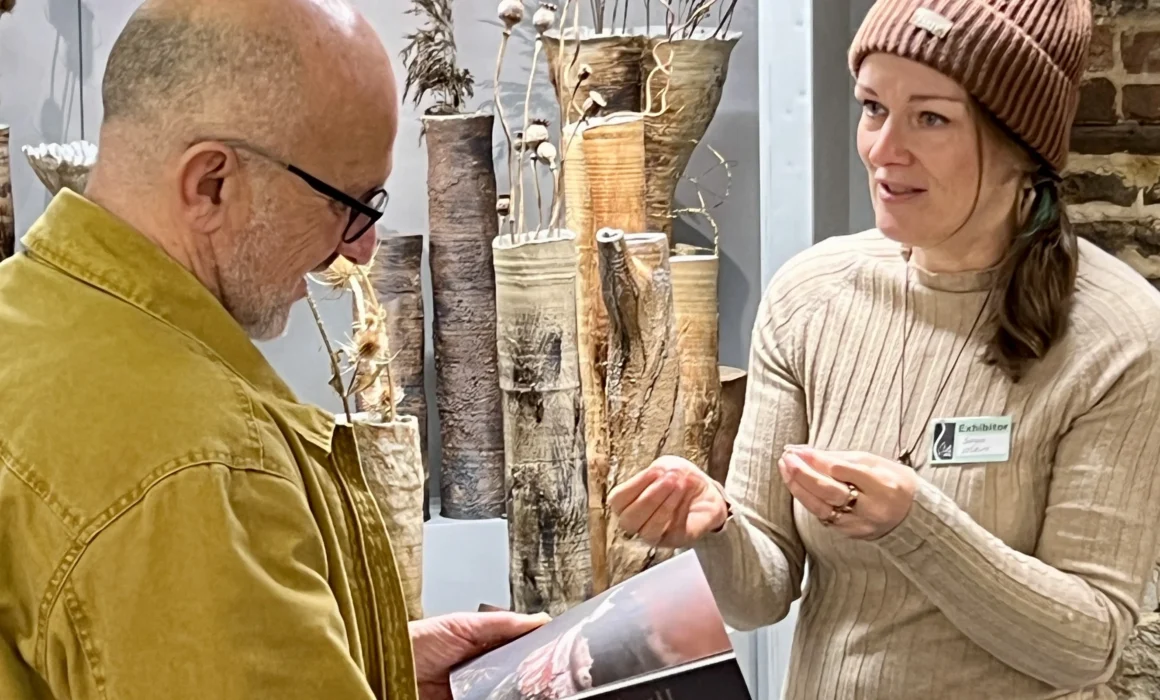
This is one of the reasons I feel drawn to sculptural ceramic vessels. They allow movement to remain visible. A curve, a slight asymmetry, a textured surface or a lifted edge can hold the memory of gesture. These marks are not accidental. They are part of the life of the piece.
In dance, the body expresses what words cannot always reach. In clay, the vessel can do the same.
Why clay became my creative language
Clay is earth held in the hands. It carries the memory of place, water, minerals and time. As my practice has evolved, especially through my MA in Fine Art Ceramics and my research into whether ceramic vessels can become activators for wellbeing, I have come to understand clay as more than a medium. It is a conduit.
My nature-inspired ceramics are shaped through walking, observing, sensing and remembering. Sometimes the starting point is a tree, a forest floor, a leaf structure, a stone surface or the feeling of being held by the landscape. These experiences move through me and return later in the studio as form.
This is where passion and presence meet. The work is not about copying nature. It is about allowing a response to emerge through the material. Clay gives that response a body.
Can handmade ceramics hold emotion?
I believe handmade ceramics can hold the quality of their making. A vessel created in haste carries a different feeling from one shaped through stillness and care. This may be subtle, but many people sense it when they encounter a piece.
There is a reason we are drawn to handmade objects. They remind us of touch, time and human presence. In a world where many things are manufactured quickly and uniformly, handmade ceramic vessels offer a different kind of experience. They invite the eye to slow down and the body to notice.
For interior designers, collectors and galleries, this is part of the value of sculptural ceramics. A piece can bring more than visual interest to a space. It can offer atmosphere, texture and a quiet sense of connection. This is why ceramic sculptures for interior designers, bespoke ceramic commissions and collectable ceramic artworks can carry such resonance within homes, galleries and carefully designed interiors.
Passion as a form of listening
As I grow older, I am less interested in passion as urgency and more interested in passion as listening. What continues to call me? What do I return to without needing to be persuaded? What brings me back into myself?
Clay does this for me. Nature does this for me. Healing work does this for me. They are not separate strands of my life, but connected expressions of the same deeper impulse. Each asks me to be present. Each reminds me that creativity is not only what we make, but how we meet the moment of making.
The passion that once moved through dance now moves through my hands into clay. It is quieter, perhaps, but no less alive. It has become part of how I understand my own path as a contemporary ceramic artist in the UK, creating work that explores nature, wellbeing and the human need for connection.
“My creative practice has always been guided by feeling first. Dance taught me to listen through the body, and clay continues to teach me how that listening can become form.”
Living with objects made through passion and presence
When a vessel leaves my studio, I hope it carries something of this process with it. I hope it becomes more than an object within a room. I hope it offers a moment of pause, a reminder of nature, and a quiet connection to the hands and presence that shaped it.
For those drawn to handmade ceramic vessels, sculptural ceramics or bespoke ceramic commissions, the invitation is often personal. A piece may speak through texture, form, colour or simply through the feeling it brings into a space.
You are invited to explore the Collections and notice which pieces resonate. If you feel drawn to discuss a commission or a particular work, the Contact page offers a simple way to begin that conversation.
As you reflect on your own life, you might ask where passion has quietly followed you. What has changed form over time, yet remained true at its centre?
References
Csikszentmihalyi, M. (1996) Creativity: Flow and the Psychology of Discovery and Invention. New York: HarperCollins.
Ingold, T. (2013) Making: Anthropology, Archaeology, Art and Architecture. London: Routledge.
Pallasmaa, J. (2012) The Eyes of the Skin: Architecture and the Senses. Chichester: Wiley.
Vallerand, R.J. et al. (2003) ‘Les passions de l’âme: On obsessive and harmonious passion’, Journal of Personality and Social Psychology, 85(4), pp. 756–767.


