
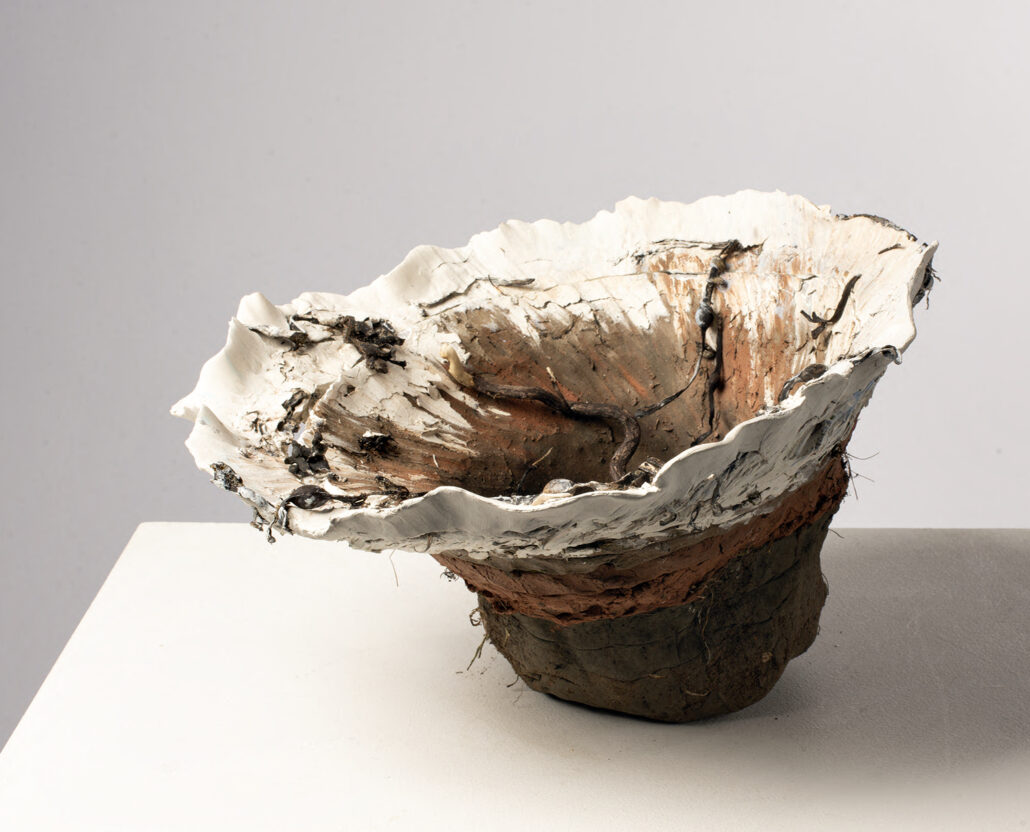
Wild Clay in Contemporary Ceramics: Foraging, Place and the Story Held in the Earth
There is something deeply grounding about knowing where clay has come from.
Most ceramic clay arrives in the studio prepared, consistent and ready to use. Wild clay begins somewhere very different. It may appear in an exposed bank, beneath a field, beside a stream or within the changing geology of a familiar landscape. Gathering it creates a direct relationship between the place I am experiencing and the material that eventually reaches my hands.
For me, this is what makes wild clay in contemporary ceramics so compelling. The material carries a genuine physical connection with landscape. Its colour, mineral content, texture and firing behaviour have developed through geological processes that began long before I arrived to work with it.
When I incorporate wild foraged clay into my ceramic practice, I feel that the landscape has become an active participant in the work.
What is wild clay?
The term wild clay generally describes clay gathered directly from the landscape and used with little or no industrial processing. In one sense, all ceramic clay begins as a natural geological material. The difference lies in what happens between the earth and the studio.
Commercial ceramic bodies are usually refined and blended to create predictable properties. A wild clay retains more of its local character. It may contain iron, sand, fine stones, organic matter and differing proportions of clay minerals such as illite, kaolinite or smectite.
British Geological Survey research shows how considerably these mineral compositions can vary between formations and even within the same geological sequence. Parts of Somerset, for example, include Lias Group clays and mudstones formed approximately 180 to 205 million years ago.
This means that local clay for ceramics is genuinely local. Two clays gathered from relatively nearby places may behave very differently in the hand and in the kiln.
Why do ceramic artists forage for clay?
My attraction to foraging clay begins with connection rather than convenience.
Gathering a small amount of clay from a place I know changes the way I understand the material. I become more aware of the ground beneath me, the geology that shaped the landscape and the length of time contained within something I might otherwise simply call clay.
There is also uncertainty in working this way. Wild clay may be highly plastic, sandy, coarse or surprisingly smooth. It may fire red, brown, buff or almost black depending upon its mineral content and firing atmosphere. This unpredictability requires listening.
Before using a newly gathered clay within finished work, ceramic artists commonly process and test small quantities to understand shrinkage, colour, texture and firing behaviour. Research into ceramic materials confirms that mineral composition, organic matter, firing temperature and atmosphere all influence what happens as clay transforms permanently into ceramic.
“Wild clay asks me to begin with curiosity. I have to discover what the material is capable of rather than deciding everything for it in advance.”
Clay as a record of place
This relationship with geology sits naturally within my wider practice of nature-inspired ceramics.
My work often begins through walking, observing and spending time with a particular landscape. Trees, woodland floors, exposed earth and natural formations become part of my visual and sensory memory. Wild clay allows the landscape to enter the work at another level because the place itself becomes material.
Sometimes I use wild clay alongside commercial clay rather than creating an entire vessel from it. It might become a surface, a slip, an inclusion or part of a wider material conversation. The distinction matters less to me than the relationship it creates.
A vessel containing clay gathered from a landscape carries something physical from that location. The connection is geological as well as conceptual.
Is wild clay more sustainable?
Wild clay is sometimes described as a sustainable ceramic material, although I think this deserves care. Gathering locally can reduce some processing, packaging and transportation associated with commercial materials. Small-scale use can also encourage makers to understand where their raw materials originate. Ceramic making still involves energy-intensive kiln firing, and removing material from landscapes carries its own responsibilities.
For me, responsible clay foraging means taking only small amounts, gathering with permission and considering the sensitivity of the place. Protected habitats, geological sites and private land require particular respect.
My Carbon Literacy training has encouraged me to think about environmental responsibility throughout my studio practice rather than attach a simple sustainable label to one material. Wild clay helps me become more conscious of material origin, which is valuable in itself.
Wild clay and contemporary sculptural ceramics
There is a beautiful tension between ancient material and contemporary ceramic art.
Humans have made objects from locally available clay for thousands of years. British pottery traditions themselves grew around geology, access to clay and fuel. British Geological Survey records show how the historic Stoke-on-Trent industry initially relied upon local clays before ceramic manufacture increasingly incorporated materials transported from elsewhere.
Working with wild clay therefore connects contemporary ceramic practice with a very old relationship between making and place.
Within my own sculptural ceramic vessels, this connection is particularly important. I am interested in clay acting as a bridge between human experience and the natural world. Wild clay makes that bridge tangible.
The material itself has already belonged to somewhere.
“Working with wild clay reminds me that I am never beginning with a blank material. The earth has already given it colour, texture, history and character long before it reaches my hands.”
Living with ceramics that carry a landscape
When a handmade ceramic vessel moves into a home, its relationship with place continues in another form.
A surface created with locally gathered clay may contain subtle variations that could never be completely replicated. These differences are part of the material’s identity. For collectors and interior designers seeking sculptural ceramics, bespoke ceramic commissions or handmade objects with a strong sense of provenance, this gives the work another layer of meaning.
The vessel can become a quiet reminder that the objects around us have origins. Materials come from somewhere, and knowing something of that story can deepen our connection with the things we choose to live with.
You are invited to explore my Collections, where nature, landscape and material are woven throughout the ceramic vessels I create. For enquiries about available work or a bespoke ceramic commission, please visit the Contact page.
Perhaps next time you walk across a familiar landscape, consider what may be beneath your feet. What histories, colours and possibilities might the earth be quietly holding?
References
British Geological Survey (2026) ‘Lias Group’. Keyworth: British Geological Survey.
British Geological Survey (2026) ‘Industrial minerals planning’. Keyworth: British Geological Survey.
Fishman, M. (2022) ‘Wild Clay and Glaze’, Ceramics Monthly. Westerville, OH: The American Ceramic Society.
Jordanova, N. et al. (2012) ‘Pottery firing temperatures: a new method for determining the firing temperature of ceramics and burnt clay’, Journal of Archaeological Science, 39(11), pp. 3473–3480.
Maritan, L. et al. (2006) ‘Influence of firing conditions on ceramic products: Experimental study on clay rich in organic matter’, Applied Clay Science, 31(1–2), pp. 1–15.
Ceramic Review (2025) ‘Masterclass: Wild Clay’. London: Ceramic Review.