


Growing Intention
Growing Intention: How Plants and Trees Grow Towards Light and Inspire Ceramic Art
There are moments in nature when growth seems to carry its own sense of direction. A branch reaches beyond the shape we expect of a tree, a climbing plant finds its way towards support, or trees on either side of a country lane gradually create an archway overhead. I find myself noticing these forms more and more, because they seem to reveal something about how living things respond to opportunity, pressure, light and one another.
I think of this as growing intention.
I use the word intention as an artistic way of describing directed, responsive growth. Botanically, plants achieve this through sophisticated biological processes including phototropism, gravitropism, touch responses and sensitivity to the light reflected by neighbouring vegetation.
The resulting forms can appear wonderfully purposeful, even when the mechanisms behind them are entirely natural.
Why do plants and trees grow towards light?
Light provides plants with the energy required for photosynthesis, so the ability to sense and respond to it is fundamental to survival. Plants possess photoreceptors that detect both the direction and quality of light. Changes in hormones including auxin then influence cell growth, allowing stems and leaves to adjust their position.
Plants can even detect the presence of neighbours before they are completely shaded. Leaves absorb red wavelengths and reflect more far-red light, altering the light environment around them.
Other plants perceive this change and may respond by elongating stems, changing leaf angles or directing growth towards a more favourable position.
Trees perform their own slower version of this continual adjustment. Their architecture develops over years in response to available light, gravity, wind and surrounding vegetation. On narrow country roads, branches from trees on both sides often extend towards the comparatively open light above the lane, eventually creating the beautiful living archways that are so characteristic of parts of the British countryside.
They appear to be reaching towards one another, while each tree is simultaneously responding to its own environment.
What can wisteria teach us about intentional growth?
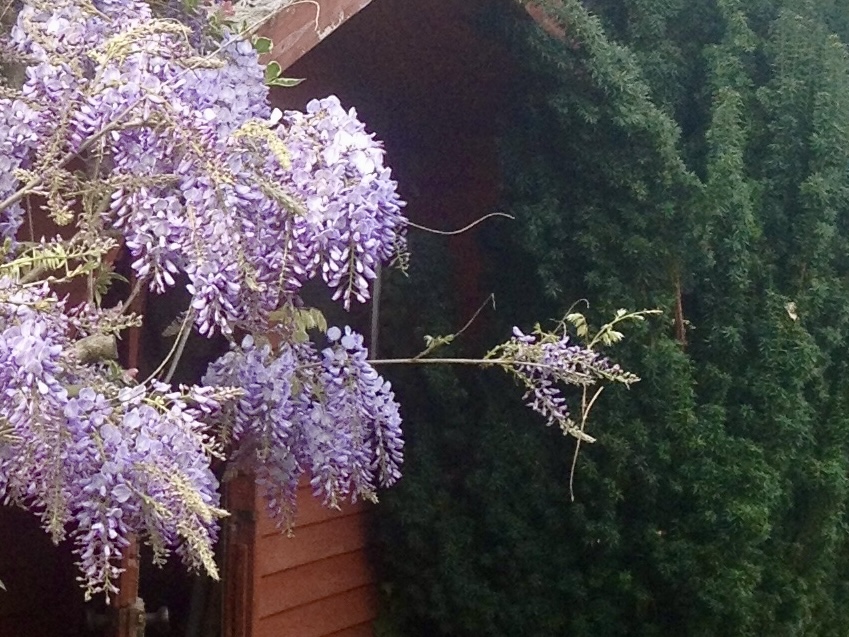
The wisteria in the garden of where I used to live, is another example I return to in my mind. Wisteria has a remarkable ability to extend beyond the form we might initially imagine for it. Its stems search, circle, meet supports and continue upwards towards light.
Research into climbing plants shows that this behaviour is highly responsive. Climbers use twining stems, tendrils and other strategies to locate and attach to supporting structures, allowing them to reach areas where more light is available. Wisteria can climb many metres into a tree or across architecture, gradually creating a completely new form through its relationship with what surrounds it.
There is something I find deeply moving about this. The plant retains its own nature while allowing its environment to influence what it becomes.
My Medlar tree at home has encouraged similar thoughts. I watch the way branches respond to space and light, extending into areas where growth is possible and gradually developing a form that could never have been predetermined at the moment it was planted.
“Nature rarely seems concerned with maintaining the form we expected of it. Growth responds to what is available, and something individual emerges through that relationship.”
How trees adapt their form to gravity and weather
Trees also have remarkable ways of responding when gravity, wind or physical disturbance alter their posture. Woody plants can create specialised tissue known as reaction wood, which develops asymmetrically and helps a leaning trunk or branch adjust its orientation.
In hardwood trees this often takes the form of tension wood, while conifers form compression wood. The tree effectively changes the structure of its own material as it grows, allowing its form to respond to mechanical forces over time.
This feels very close to the way I experience clay. Material is never passive. Its properties participate in the final form. That became particularly important during the making of my sculpture Beneath, Between, Beyond.
When porcelain began to find its own direction
The porcelain branches emerging from Beneath, Between, Beyond were originally formed and attached with a particular shape in mind. During firing, something happened that transformed my relationship with the piece.
As porcelain vitrifies at high temperature, glassy phases form within the ceramic body and the material becomes temporarily less rigid. Thin or unsupported sections can begin to move under their own weight and gravity, a process known technically as pyroplastic deformation. My porcelain branches moved.
When I opened the kiln, they had shifted from the positions in which I had placed them. Some curved, some leaned and others appeared to reach into the space around them.
The result carried far more energy than I could have consciously constructed.
The heat, gravity, weight and material qualities of porcelain had all participated in the sculpture. Their movement gave the branches a sense of direction that felt remarkably similar to the responsive growth I observe in trees.
“The branches seemed to have found their own intention in the kiln. Their movement brought a vitality to the sculpture that my hands alone could never have planned.”
Nature-inspired ceramic art and the energy of movement
This experience has become important within my fine art research because it has encouraged me to think differently about nature-inspired ceramic art.
Responding to nature does not always mean reproducing its appearance. It can involve allowing some of the same principles of movement, adaptation and material response to exist within the making process itself.
My sculptural ceramic vessels increasingly explore this relationship. Clay carries its own possibilities, just as a tree carries possibilities within its growth. Pressure, gravity, heat, moisture and time all influence what eventually emerges.
There is an energy in forms that have been allowed to respond.
Perhaps this is why we find an unexpected branch, a twisted wisteria or an arch of trees above a country road so compelling. We can sense the history of movement within the finished form. We are seeing years of response made visible.
When I look again at Beneath, Between, Beyond, I see the porcelain branches reaching outwards and think about everything that influenced their journey: my hands, the clay, the kiln, heat, gravity and chance. Growing intention, for me, lies somewhere within this relationship.
As you walk beneath trees or through your own garden, perhaps notice the forms that have travelled beyond what seems expected. Where is a branch reaching for light, finding another tree, moving around an obstacle or quietly adjusting its course?
What might that movement tell you about your own capacity to grow in response to what surrounds you?
References
Ballaré, C.L. and Pierik, R. (2017) ‘The shade-avoidance syndrome: multiple signals and ecological consequences’, Plant, Cell & Environment, 40(11), pp. 2530–2543.
Gianoli, E. (2015) ‘The behavioural ecology of climbing plants’, AoB PLANTS, 7, plv013.
Moulia, B. and Fournier, M. (2009) ‘The power and control of gravitropic movements in plants: a biomechanical and systems biology view’, Journal of Experimental Botany, 60(2), pp. 461–486.
RHS (2026) ‘How plants sense and respond to the environment’. Royal Horticultural Society.
RHS (2026) ‘How to grow wisteria’. Royal Horticultural Society.
Yang, C. et al. (2024) ‘Light and light signals regulate growth and development in woody plants’, Forests, 15(3), article 523.
Zanelli, C. et al. (2019) ‘Revisiting pyroplastic deformation: application for porcelain stoneware tile bodies’, Journal of the European Ceramic Society, 39(2–3), pp. 601–609.


