


How Landscape, Trees and Clay Shape Contemporary Ceramic Art
Nature Inspired Ceramics: How Landscape, Trees and Clay Shape Contemporary Ceramic Art
Nature has become so interwoven with my ceramic practice that I find it difficult to separate the two. A walk through woodland, the changing surface of a tree, exposed earth at the side of a path or the way a landscape shifts with weather can all find their way into the studio with me.
I rarely return wanting to reproduce exactly what I have seen. What stays with me is usually a feeling, texture, movement or sense of connection. These memories settle for a while and eventually emerge through clay.
This is what nature inspired ceramics means within my own practice. Nature is more than a visual reference. It influences how I observe, how I work with materials and how I understand the ceramic vessel as a bridge between human experience and the natural world.
How does landscape inspire contemporary ceramic art?
Landscape contains layers of information. Geology sits beneath vegetation, trees record seasons of growth, and weather continually alters surfaces. When I walk, I become aware of these relationships and of how slowly many natural forms have developed.
That sense of time influences my making.
Clay itself is geological material, created through the weathering and transformation of rock over
immense periods. Working with it already places a ceramic artist in relationship with landscape before a form has even been created.
My Landscape Vessels explore this connection through surface, proportion and material response. Marks may originate in rock formations, soil, distant horizons or the textures I have encountered while walking. They become translations of landscape rather than representations of it.
Contemporary ceramic art increasingly allows clay to operate in this wider conceptual space. The V&A describes studio ceramics as encompassing everything from functional vessels to sculpture and installation, while current museum research considers an even broader “expanded field of clay”. For me, this freedom allows the vessel to remain connected with its ancient history while carrying contemporary ideas about place, wellbeing and ecological relationship.
Why are trees such an important influence on my ceramics?
Trees have become some of my most persistent teachers. I notice their surfaces, their ability to adapt, the ways branches seek available light and the relationships they form within woodland communities. I am particularly fascinated by what happens beneath the visible tree, where roots interact with fungi, microorganisms and neighbouring plants.
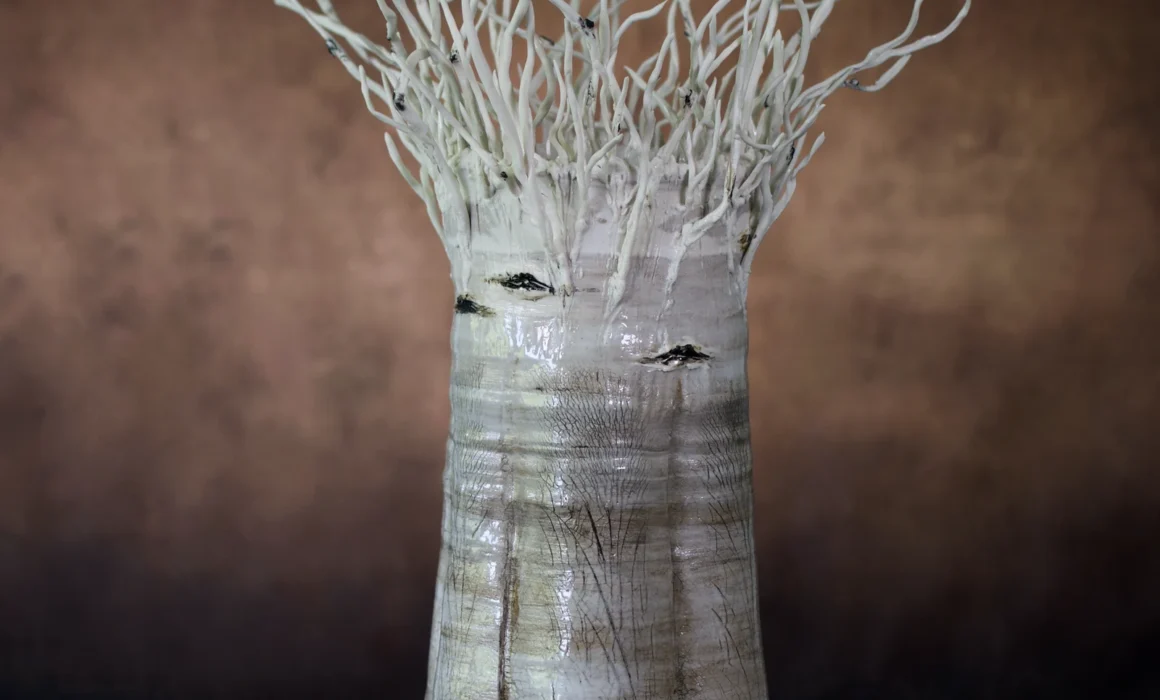
My Tree Vessels have developed through these observations. Bark may influence a textured surface, while branching structures appear through form and mark-making. Sometimes the influence is less visible. A vessel may carry something of the strength, resilience or quiet presence that I experienced while standing beside a particular tree.
“Trees rarely ask to be noticed, yet the longer I spend with them, the more I become aware of growth, connection and adaptation taking place around me.”
This relationship also informed my sculpture Beneath, Between, Beyond, where porcelain branches extend from a vessel form, referencing the visible and hidden connections through which trees interact with their environments.
Clay as a material connection with nature
My recent exploration of wild clay in contemporary ceramics has made this relationship even more direct.
When a small quantity of clay is responsibly gathered from a landscape, that place becomes physically present within the artwork. Its mineral content, colour and firing response belong to a particular geology.
I sometimes combine wild foraged clays with commercial ceramic bodies and organic materials, allowing different sources of earth to meet within the same vessel. This creates an intimate material dialogue between place, artist and firing process.
The clay retains agency throughout. It shrinks, moves and responds to heat. Glazes change.
Porcelain can soften during vitrification. Some of my most meaningful discoveries have happened when the material has moved beyond what I originally intended.
Nature works in much the same way. Growth responds continually to circumstance.
Nature inspired ceramics and biophilic connection
My MA research asked whether ceramic vessels could become activators for wellbeing, and biophilic connection remains central to this enquiry.
Biophilia describes the human affinity with nature and living systems. Research consistently associates exposure to natural environments with positive emotional effects, while more recent studies suggest that nature-themed artwork within interiors may also have restorative qualities.
I approach these findings carefully. A ceramic vessel is not a medical intervention. What interests me is its capacity to remind us of something beyond the interior in which it sits.
A surface may recall bark beneath the fingertips. The earth colours of a vessel may bring to mind soil or stone. An organic form may feel familiar because it carries rhythms we recognise from the natural world.
These small connections can encourage attention and presence.
“My hope is that a vessel carries something of the landscape with it, allowing nature to remain quietly present within the spaces where we live.”
Nature inspired sculptural ceramics for interiors and collectors
This is also why I believe sculptural ceramics for interiors can have such a meaningful presence.
Natural materials introduce texture, individuality and sensory depth into interior spaces. A handmade vessel changes as daylight moves across it and reveals different aspects of its surface
throughout the day.
For collectors seeking collectable ceramic artists or interior designers looking for ceramic sculptures for interior designers, provenance and artistic intention can be as important as visual form. Knowing where an idea originated, how the material was handled and why particular surfaces developed creates another layer through which the artwork can be understood.
A bespoke ceramic commission can take this relationship further, allowing a vessel to respond to a particular landscape, place or personal connection with nature.
Translating nature rather than copying it
As my practice develops, I increasingly understand my role as a translator.
I spend time within landscapes, absorb something through observation and experience, then return to clay. What emerges has passed through memory, touch and material before becoming form.
The finished vessel therefore carries several relationships at once: earth and fire, landscape and interior, maker and material, nature and human experience.
You are invited to explore my Tree Vessels, Earth Vessels and Landscape Vessels within the Collections section of my website. For enquiries about available work, gallery collaborations or a bespoke ceramic commission, please visit the Contact page.
Perhaps the next time you encounter a handmade ceramic vessel, look a little longer at its surface and form. What part of the natural world does it bring to mind, and how does that connection make the space around it feel?
References
Gaekwad, J.S., Sal Moslehian, A., Roös, P.B. and Walker, A. (2022) ‘A meta-analysis of emotional evidence for the biophilia hypothesis and implications for biophilic design’, Frontiers in Psychology, 13, 750245.
Pallasmaa, J. (2012) The Eyes of the Skin: Architecture and the Senses. Chichester: Wiley.
Victoria and Albert Museum (2025) ‘Studio Pottery: an introduction’. London: Victoria and Albert Museum.
Victoria and Albert Museum (2026) ‘Future Ecologies of Clay’. London: Victoria and Albert Museum.
Wilson, E.O. (1984) Biophilia. Cambridge, MA: Harvard University Press.
Zhang, Y. et al. (2025) ‘Restorative effects and perception of nature-themed artworks in indoor environments: an empirical study based on VR+EEG’, Frontiers in Psychology.


