


Wellbeing in Art
Wellbeing in Art
There is a particular kind of stillness that arrives when I am sitting in nature with clay in my hands. It is not an empty stillness. It feels alive, held by the trees, softened by the moss beneath me and shaped by the quiet rhythm of breath. In these moments, art is not separate from wellbeing. It becomes a way of returning to the body, to the earth and to a more spacious way of being.
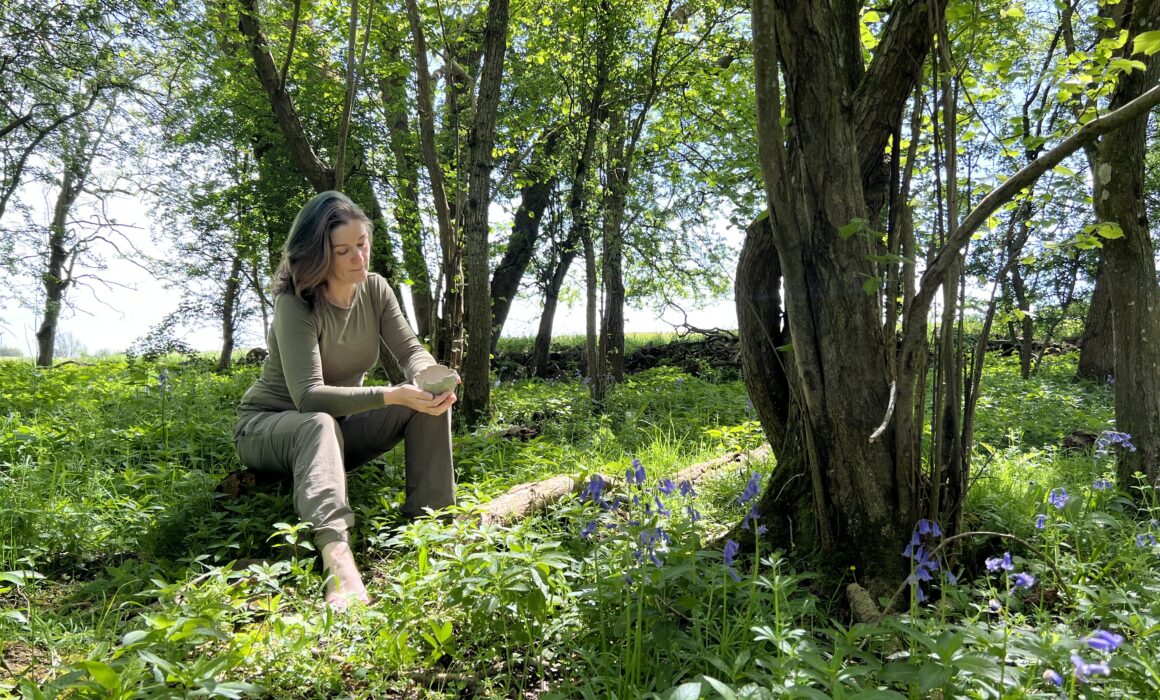
The image of sitting within woodland, holding a ceramic vessel close, reflects something central to my practice. Clay, nature and presence are not separate strands of my life. They meet through making, through healing work and through the simple act of listening. When I work with clay, I am often aware that the vessel I am holding has come from the earth and will carry something of that relationship forward into the spaces it enters.
What does wellbeing in art mean?
Wellbeing in art is not only about looking at something beautiful. Beauty can soothe us, although the deeper experience often comes through connection. A piece of art may help us feel grounded, understood or quietly accompanied. It may bring memory, texture, place or meaning into a room. It may invite the nervous system to soften because something in the form feels familiar, natural or held.
Research into arts and health increasingly recognises that creative engagement can support wellbeing across many stages of life. The World Health Organization’s evidence review found that the arts can play a role in prevention, health promotion and the management of illness. This does not mean art should be reduced to a tool or treatment. It means that the human relationship with making, seeing, hearing and experiencing art is deeply connected to how we live and feel.
For me, wellbeing in art begins with the quality of presence brought to the making. A vessel shaped with patience carries a different feeling from one made in haste. Clay records touch, pressure and attention. It shows where the hand has listened and where the material has been allowed to guide the form.
“My vessels are not created to fix or distract. They are created to hold presence, and sometimes that presence is enough to help someone feel quietly reconnected.”
How nature-inspired ceramics support wellbeing
Nature has always been one of the most reliable places for me to reset. Sitting among trees, feeling the softness of the forest floor and breathing in the layered scent of woodland brings me back into myself. When I take clay into that environment, or later return to the studio with the memory of it, the work becomes part of a wider relationship between landscape and body.
Nature-inspired ceramics can support wellbeing because they carry reminders of the natural world into interior spaces. A textured vessel may echo bark, earth, stone, lichen or weathered ground. A curve may feel like growth, movement or shelter. These references do not need to be literal. Often, the body recognises them before the mind names them.
This connects closely with biophilia, the idea that humans have an innate affinity with living systems and natural forms. Research into nature connectedness suggests that people who feel more connected to nature often report higher levels of positive affect, vitality and life satisfaction. Within a home, gallery or contemplative space, ceramic vessels can become quiet anchors for that connection.
Why clay feels grounding
Clay is one of the most honest materials I know. It responds immediately to the hand. It asks for pressure, moisture, balance and time. If I move too quickly, it tells me. If I am distracted, it shows me. This makes clay a deeply grounding material because it brings attention back into the present moment.
There is something profoundly regulating about working with a material that has weight, texture and resistance. The hands become more awake, breath slows, and thought begins to settle. In this sense, clay can become a partner in embodied awareness.
As a Reiki Master Teacher, Crystal Therapist and ceramic artist, I often experience wellbeing through the subtle relationship between energy, body and material. Clay has its own quiet intelligence. It comes from the earth, holds water, responds to air and is transformed through fire. Each element plays a part in the vessel’s becoming.
Art as a bridge between inner and outer worlds
My MA research asked whether ceramic vessels can become activators for wellbeing. That question continues to guide me. I am interested in how sculptural ceramic vessels can act as a bridge between human experience and the natural world. A vessel may be placed on a shelf, table or plinth, yet its influence can be felt more quietly than its position suggests.
The vessel has an inner space. Even when empty, it holds possibility. It may hold flowers, light, shadow, memory or silence. It may hold a moment of pause in an otherwise busy room.
For collectors, interior designers and gallery owners, this is part of the value of contemporary ceramic art. Sculptural ceramics can bring texture, form and meaning into a space while also supporting a more grounded atmosphere. They invite slower looking and a more sensory kind of attention.
“Clay helps me translate what I feel in nature into form. Each vessel becomes a quiet conversation between earth, hand and the person who chooses to live with it.”
Living with art that supports presence
Wellbeing in art does not need to be dramatic. It can be found in the daily act of noticing. The way light rests on a vessel in the morning. The way a surface invites the eye to slow down. The way a handmade object reminds us that not everything meaningful is instant or uniform.
When a ceramic piece is made with presence, it can bring that same quality into a room. It does not demand attention. It simply offers a place for attention to rest.
As you think about the art you choose to live with, you might notice how certain objects affect your breath, your posture or your sense of calm. Which pieces help you feel more connected to yourself, to nature, or to the quiet ground beneath everything?
References
Capaldi, C.A., Dopko, R.L. and Zelenski, J.M. (2014) ‘The relationship between nature connectedness and happiness: a meta-analysis’, Frontiers in Psychology, 5, article 976.
Fancourt, D. and Finn, S. (2019) What is the evidence on the role of the arts in improving health and well-being? A scoping review. Copenhagen: WHO Regional Office for Europe.
Hansen, M.M., Jones, R. and Tocchini, K. (2017) ‘Shinrin-Yoku (Forest Bathing) and Nature Therapy: A State-of-the-Art Review’, International Journal of Environmental Research and Public Health, 14(8), article 851.
Jimenez, M.P. et al. (2021) ‘Associations between nature exposure and health: a review of the evidence’, International Journal of Environmental Research and Public Health, 18(9), article 4790.
Pallasmaa, J. (2012) The Eyes of the Skin: Architecture and the Senses. Chichester: Wiley.


