


Creating in Presence
Creating in Presence
“The key to spiritual growth and freeing ourselves from this worldly thinking is realising that it is the presence with which we do something that matters, not what we do.” Hollie Holden, ACIM
This sentence has stayed with me for some time. It feels simple, yet it asks something profound of us. It suggests that transformation is not located in achievement, productivity or visibility, but in the quality of attention we bring to each moment.
In my own life, this has become most apparent in the studio.
When I enter the space where I work with clay, there is always the temptation to think about outcomes. What will this piece become? Will it be well received? Does it align with a collection? Those thoughts arise easily. They are part of living in a world that measures and evaluates.
Yet I have learned that when I create from that place alone, something feels slightly disconnected. The work may be technically sound, but it lacks depth. It is only when I soften my focus and return to presence that the clay begins to respond differently.
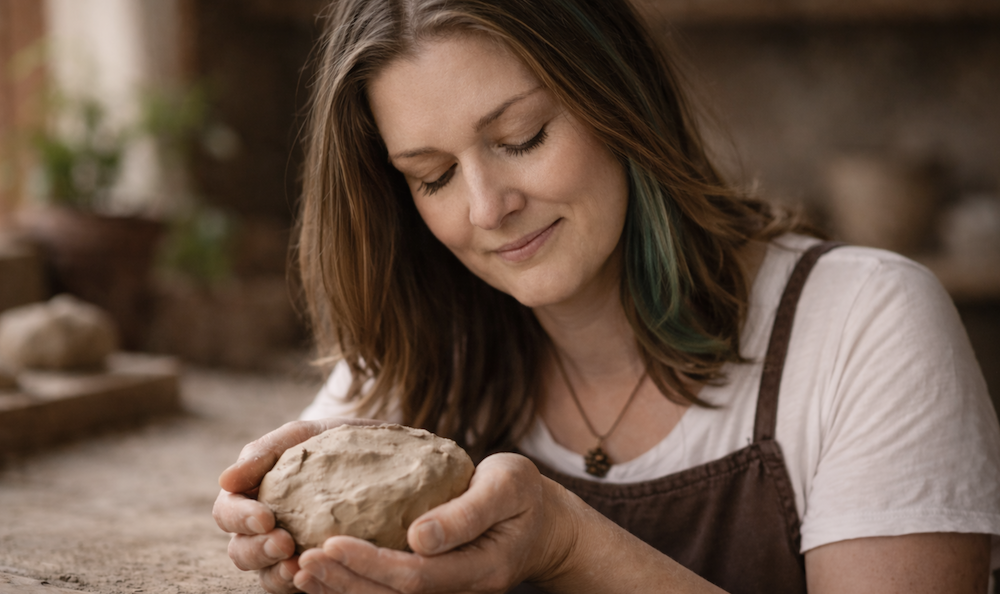
Presence, for me, begins with the body. I notice my breath. I feel the weight of the clay in my hands. I sense the temperature of the studio, the texture of the surface beneath my fingertips. These small acts of attention anchor me. They draw me away from mental projection and into immediate experience.
In this state, the making becomes less about producing and more about listening.
Clay is honest. It does not respond well to force or distraction. If I am unsettled, it shows in the tension of the form. If I am calm and attentive, the vessel often carries a quiet steadiness. This is not mystical. It is relational. The material mirrors the energy with which it is handled.
The quotation from Hollie Holden resonates because it reflects what I experience daily. Spiritual growth, in my understanding, is not separate from ordinary life. It is not confined to meditation cushions or retreats. It is expressed in how I shape a rim, how I smooth a surface, how I pause before altering a curve.
The presence I bring to these actions changes the quality of the outcome, yet it also changes me.
There is research to support the value of this kind of attentive engagement. Studies in mindfulness and contemplative practice show that sustained, non-judgemental awareness of present-moment experience can reduce stress, enhance emotional regulation and support neural integration. Activities that involve repetitive, tactile focus, such as working with clay, naturally invite this state. They slow mental rumination and encourage embodied awareness.
I notice that when I create in presence, time feels different. It expands. The pressure to complete fades. What remains is a gentle concentration that feels nourishing rather than depleting. Even if the piece does not survive the kiln, the time spent with it has already offered something valuable.
This understanding has gradually extended beyond the studio.
When I am with a Reiki client, the same principle applies. The techniques matter, yet what truly shapes the session is the quality of attention I bring. Am I fully there, or am I subtly preoccupied? Clients often sense the difference before I do. Presence is palpable.
The same is true in nature. When I walk among trees, I can choose to think through problems or I can allow myself to simply experience the movement of light, the sound of leaves, the texture of ground underfoot. The latter shifts something inside me. It feels as though the boundary between inner and outer softens.
Creating in presence becomes a practice of freedom. It frees me from the need to measure every action against an imagined future. It frees me from the belief that worth is located in visible results. It brings me back to the simplicity of this moment, this breath, this touch of clay.
There are days when I forget. I move too quickly. I compare. I strive. On those days, the work feels heavier. Returning to presence is rarely dramatic. It is often as small as placing my hands on the clay and pausing long enough to feel its quiet solidity.
In that pause, something opens.
The world encourages us to focus on what we are doing and how it appears. Presence asks a different question. How are we being while we do it?
When I shape a vessel from this place, I sense that it carries more than form. It carries the quality of attention with which it was made. Perhaps this is why certain objects feel calm or grounding in our homes. They hold the residue of presence.
As you reflect on your own creative or daily practices, you might ask yourself where your attention rests. Is it ahead of you, measuring and anticipating, or is it here, in the texture of what you are touching right now?
The invitation is gentle. It is not to change what you do, but to notice how you are while you do it.


